The dramatic masterpiece St Mary Magdalene in Ecstasy by the master of Baroque art Caravaggio arrives for display at the Radvila Palace Museum of the LNMA
The exhibition is open from 4 June 2026
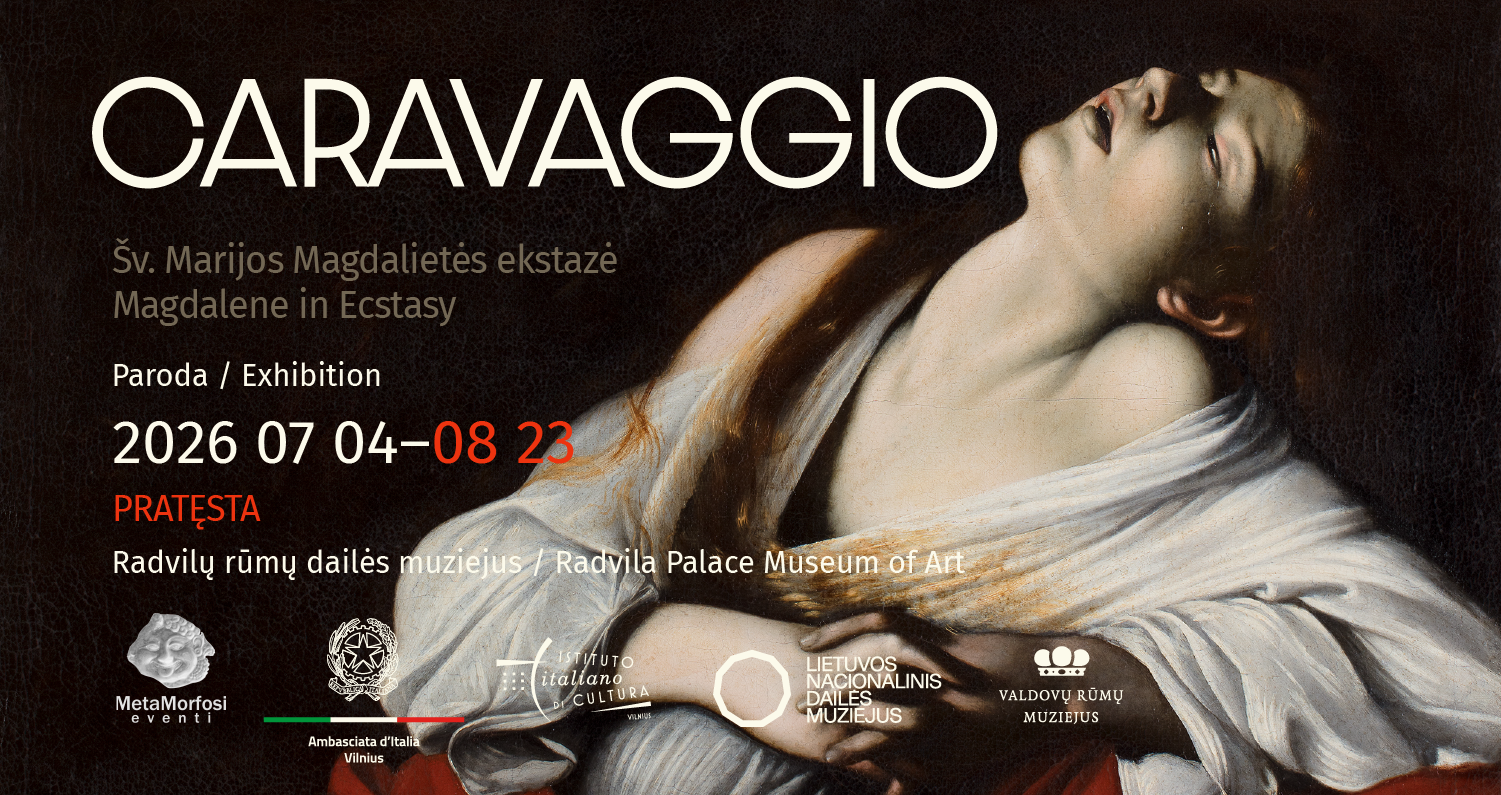 From the 4th July, St Mary Magdalene in Ecstasy, a masterpiece by one of the most unorthodox figures in the European history of art, Michelangelo Merisi da Caravaggio, better known as Caravaggio, goes on display at the Radvila Palace Museum of Art of the Lithuanian National Museum of Art (the LNMA), having already captivated visitors of the Palace of the Grand Dukes of Lithuania.
‘We are pleased by the increasingly intense collaboration of the Lithuanian National Museum of Art with the Italian cultural institutions, which opens opportunities to the Lithuanian public to experience the top level heritage of the cultures of the world first-hand. The exhibition of the masterpiece by Caravaggio at the Radvila Palace Museum of Art is a result of our mutual trust and joined commitment to preserve and share the artistic heritage of Europe. We owe a debt of gratitude to the Ambassador of Italy to Lithuania Emanuele de Maigret for his personal attention and a helpful hand in realizing this project, and to the President of the Chamber of Deputies’ Committee on Culture, Federico Mollicone for his continuous support to the strengthening of bilateral cultural cooperation between Lithuania and Italy. I extend my heartfelt gratitude to the Palace of the Grand Dukes of Lithuania in Vilnius, especially, the Director of the museum Vydas Dolinskas for his efficient partnership in carrying out this project, to the Italian cultural institution Associazione MetaMorfosi and the Director General of the Association Vittorio Faustini for the confidence showed in lending the piece of art and all logistical support. We are positive that this impressive project brought to fruition will pave the way for many other consequential international initiatives which serve to enrich cultural life in Lithuania,’ the Director General of the LNMA Dr Arūnas Gelūnas has stated.
The controversy, which Caravaggio’s unorthodox style and his action-packed life earned him, did not hinder the painter’s immense recognition neither prevent him from obtaining numerous commissions during his life-time. His interpretations of the religious subject matter seemed to go against the grain of traditional sacred art. However, by choosing models from everyday life and emphasizing human fragility to heighten emotional impact of his scenes, the painter anchored his art in the defining pillars of the Baroque aesthetic: drama, emotion, and viewer inclusion. He created a new relationship between a work of art and its viewer by bringing art closer to life and transforming it into an extension of daily experience.
The mysterious witness
Mary Magdalen is one of the most mysterious figures in the history of Christianity. Caught in a moment of ecstasy in Caravaggio’s canvas, Mary Magdalen – the apostle of apostles – seems to veritably emerge from the painting. Her pale skin and arched neck cut through the dense darkness of the background, her loose shiny tresses play in the folds of her dress. The face turned upwards, the expression of a blissful stillness, tears trickling down her cheek suggest the saint is visited by a mystical vision, a sensory and heavenly experience recurrent in the paintings of the Baroque epoch. While the saint woman turns to the Divine, we cannot turn away from her.
The biblical Mary Magdalen was the woman who had seven demons exorcised from her before becoming one of the most devoted Jesus’s disciples and the first witness of His resurrection. The painting most likely depicts the last day of Magdalen’s life after thirty reclusive years she spent in a cave. The Golden Legend, 13th-century collection of hagiographies, has it that Mary Magdlen was then visited by Maximin, Bishop of Aix, who came to administer the Eucharist to her. Mary wept for joy, received Communion, and died. This narrative inspired the two most celebrated depictions of Mary Magdalene in Western art: the Penitent Magdalene and the Magdalene in Ecstasy, the latter being the subject of Caravaggio’s painting. St Mary Magdalene in Ecstasy, arriving from the Palace of the Grand Dukes of Lithuania, will be displayed in the Radvila Palace Museum of Art rooms featuring 16th -18th-century Western European paintings of religious passions. The Italian master will hang among Italian, Spanish and Flemish paintings of similar periods depicting powerful spiritual experience.
Original beyond doubt
According to Mina Gregori, a distinguished Caravaggio scholar and professor at the University of Florence, this Magdalene is unquestionably an original work by the master of Baroque painting. Several distinctive aspects of the picture support this view. Principal among them are the hands, an important element in Caravaggio’s work. The tonal transitions and contrasts that render the image of firm yet elegant palms suggest that the composition could only have been painted from life, not copied by imitators. The gleaming tear on Magdalene’s cheek exemplifies the subtle realism characteristic of the artist. Her mantle is distinguished by the vivid red tone that recurs throughout Caravaggio’s oeuvre, alongside broad, freely rendered drapery folds.
Caravaggio’s St Mary Magdalene in Ecstasy epitomizes the defining features of the Baroque painting – the drama of the narrative and the manner of painting dependant on strong contrasts of light and shadow known as chiaroscuro, even, tenebrism. Caravaggio’s thorough exploration of the effects of light establishes him as an exceptional master of painting whose virtuosity over time paved the way to modern painting techniques.
The masterpiece by Caravaggio St Mary Magdalene in Ecstasy will be on at the Radvila Palace of the LNMA until the 2nd August. Guided tours, planned by the museum, will enhance visitor experience of looking at the masterpiece. The Lithuanian National Museum of Art invites to see yet another exhibition, at the Vilnius Picture Gallery, of the canvas The Caravaggio Question: The Painting “The Taking of Christ” attributed to Caravaggio and brought to Lithuania from the Odesa Museum of Western and Eastern Art in Ukraine.
The project is realized by the Lithuanian National Museum of Art in collaboration with the Italian Embassy in Lithuania, the Italian Culture Institute in Vilnius, the Museum of the Palace of the Grand Dukes of Lithuania, and the Cultural Association
MetaMorfosi dedicated to the enhancement and promotion of Italian cultural heritage worldwide.
Radvila Palace Museum of Art,
24 Vilniaus st, LT-01402, Vilnius, Lithuania
+370 5 250 5824