CARAVAGGIO. Magdalene in Ecstasy
4 July – 23 August, 2026
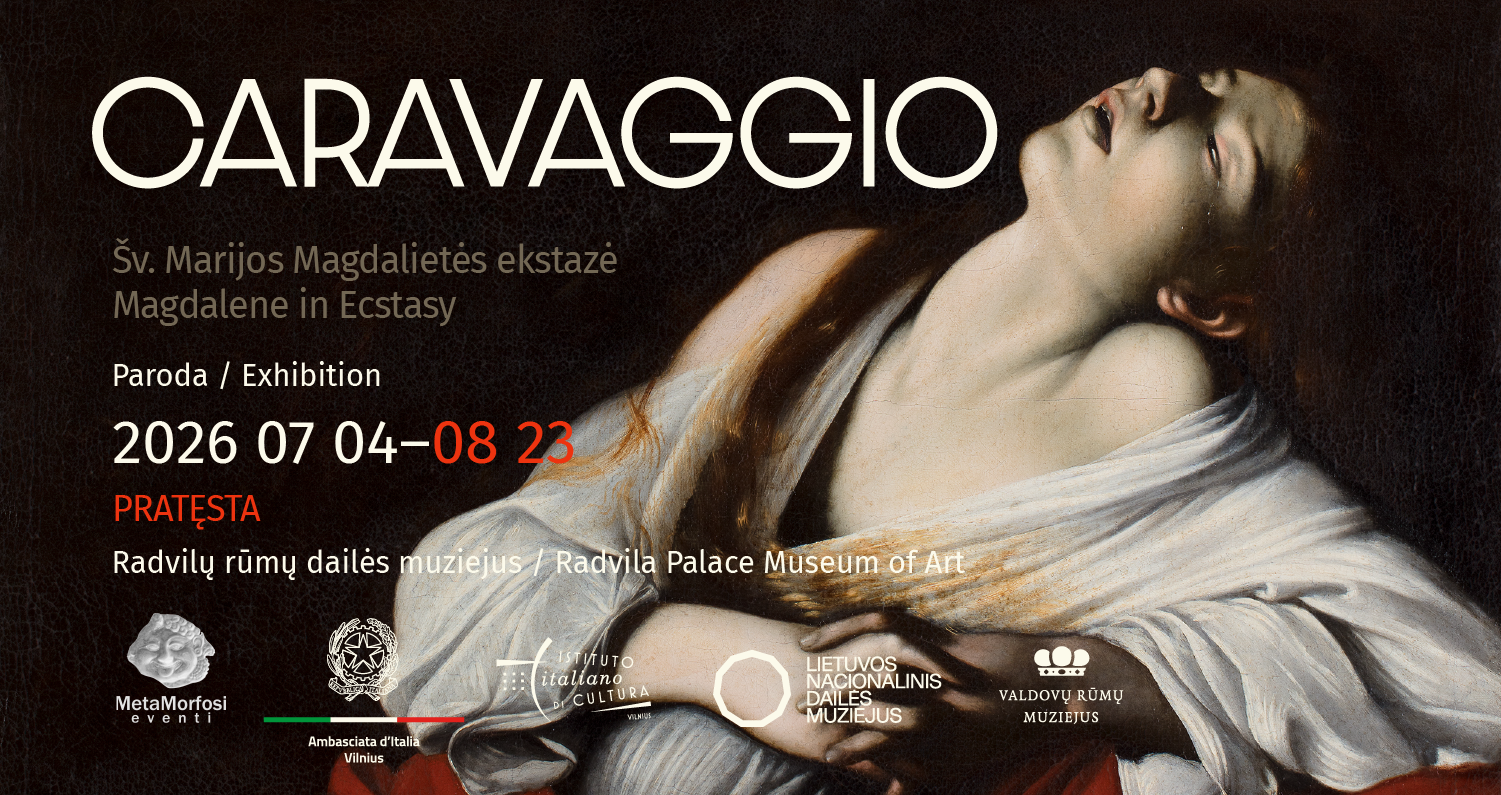
Mary Magdalene – apostle of the apostles – appears to emerge from the surface of the painting at the very moment of ecstasy. Her pale skin and arched neck cut through the darkness that envelops the background, while loose curls gleam among the dynamic folds of her garment. Her face is thrown back towards the heavens; the expression of rapt stillness and the tears coursing down her cheek suggest a vision being experienced – at once sensory and otherworldly, recurring throughout paintings of the Baroque period. As the holy woman turns towards Providence, the viewer cannot look away from her.
Mary Magdalene is one of the most intriguing figures in the history of Christianity. Healed from the “seven demons” (Mk 16:8; Lk 8:2), she became one of Christ’s most devoted followers and the first witness to his resurrection. The painting appears to depict the last day of Magdalene’s life, following thirty years of solitary existence in a cave. According to the 13th-century Golden Legend, a compendium of saints’ lives, Mary Magdalene was visited by Maximinus, Bishop of Aix, a town near Provence, who came to administer the Eucharist to her. Mary wept for joy, received Communion, and died. This narrative inspired the two most celebrated depictions of Mary Magdalene in Western art: the Penitent Magdalene and the Magdalene in Ecstasy, the latter being the subject of Caravaggio’s painting.
According to Mina Gregori, a distinguished Caravaggio scholar and professor at the University of Florence, this Magdalene is unquestionably an original work by the master of Baroque painting. Several distinctive aspects of the picture support this view. Principal among them are the hands, an important element in Caravaggio’s work. The tonal transitions and contrasts that render the image of firm yet elegant palms suggest that the composition could only have been painted from life, not copied by imitators. The gleaming tear on Magdalene’s cheek exemplifies the subtle realism characteristic of the artist. Her mantle is distinguished by the vivid red tone that recurs throughout Caravaggio’s oeuvre, alongside broad, freely rendered drapery folds.
At the lower right of the painting, a skull is visible, which is a typical attribute of Mary Magdalene in Christian iconographic tradition, alongside a cross and a crown of thorns. These symbols are turned not towards the saint but towards us, the viewers, who are invited to meditate upon the Passion of Christ, an experience the saint has already inwardly known. In the 17th century, while Caravaggio was painting the Magdalene, he was deeply engaged in Counter-Reformation debates concerning faith, sanctity, and the significance of sacred images. The painting gives vivid expression to the defining characteristics of Baroque painting: dramatic narrative and the contrasting pictorial technique known as chiaroscuro. The result of sustained observation of light distinguishes Caravaggio as an exceptional painter, whose virtuosity eventually paved the way for modern painting techniques.
Michelangelo Merisi da Caravaggio is one of the most revolutionary figures in the history of European art. Named after the Italian town of Caravaggio, he trained as a painter in Milan and worked in various Italian cities in the late 16th and early 17th centuries. Though his innovative style and turbulent personal life provoked conflicting assessments, he attained considerable recognition and received numerous commissions during his lifetime. Caravaggio’s interpretations of religious subjects were regarded as subversive by his contemporaries. By using models drawn from everyday life and emphasising human frailty, he heightened the emotional force of his scenes, embodying the dramatic intensity, immediacy, and engagement of the viewer that are characteristic of the Baroque. At the same time, Caravaggio forged a new relationship between the work and the viewer, narrowing the distance between art and life, rendering the work of art as an extension of everyday experience. His life was marked by violence, exile, and constant movement. In 1606, having killed a man, most likely due to a dispute over gambling debts or a personal quarrel, Caravaggio was forced to flee Rome. He died in 1610 near Porto Ercole in Tuscany, in circumstances that have never been fully explained. It is believed that he was travelling by sea with his paintings, hoping to achieve a reconciliation with the papal court and recover the right to return to Rome.
Radvila Palace Museum of Art,
24 Vilniaus st, LT-01402, Vilnius, Lithuania
+370 5 250 5824