Exhibition "Colours and Hues. Baltic Amber in the Collection of Ramutis Petniūnas"
18 May - 31 December 2018
 The colour of Baltic amber (succinite) depends on its structure and on the conditions under which it formed. The main colour of clear amber is yellow, varying from light to brown, even to reddish tones. There can be around 100 yellowish tones alone. Amber’s structural elements have the most impact on its colour – the bubbles of terpentine gas and the density of their distribution. The more bubbles there are, the whiter the amber. The terpentine gas evaporated very slowly from resin that happened to be out of direct sunlight, that is why this resin hardened slowly and remained clear. One cubic millimetre of white amber, which looks almost like ivory (it is also called bone amber), can contain up to 900,000 gas bubbles. During the course of chemical processes, various soil impurities can give amber a blue or green shade. Natural amber pieces are covered in an oxidation skin. The skin of amber excavated from the ground is thicker and its form is more varied, while amber that has been eroded by the waves in the sea and the sand has a thinner, lighter skin.
Amber comes in the following main colours: clear, semi-clear, foam, crystallized, white (bone), blue, green.
Freshly polished amber emits a blue-coloured shine under UV rays.
Modern technologies allow changing the colour of amber. It can be clarified under pressure of several atmospheres, when amber is affected by inert gases. As amber is heated, it becomes brownish, or even red in colour. However chemically or thermally affected amber loses all its natural qualities and its value.
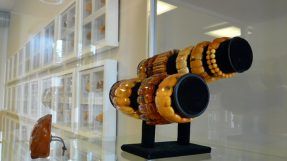
More than 350 Baltic amber hues samples and 100 amber bracelets created by Lithuanian artists are shown in the exhibition.
17 Vytauto st, LT-00101, Palanga, Lithuania
(+370 460) 30314
gintaro.muziejus@lndm.lt