Henrikas Šalkauskas (1925–1979). The Little Retrospective. Exhibition
19 September - 19 November.
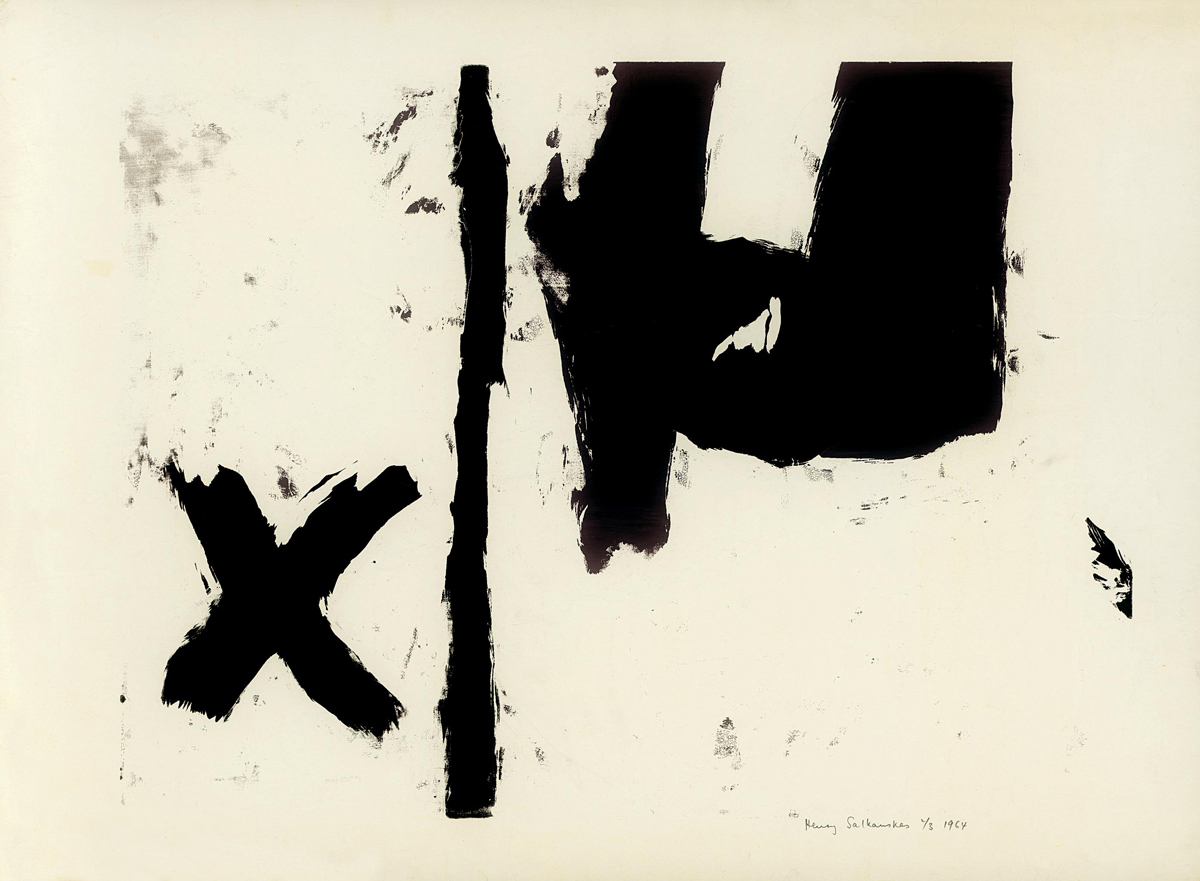
This retrospective of artist Henry Salkauskas is the first in Lithuania. The exhibition presents a collection of Salkauskas’ paintings and graphic art works donated to the Lithuanian Art Museum by his close friend and life partner, acknowledged Australian artist, Eva Kubbos. The artist’s work from 1959 to 1979 is on display, reflecting twenty years of creative activity. The donated collection complements the artist’s works from the Lithuanian Art Museum’s rich collection of émigré Lithuanian artists’ pieces.
Salkauskas rose to prominence in the modern Australian art scene in the 1950s–1960s when curators and art critics noticed imported European art traditions in this artist’s work which organically resonated with the global art trends prevailing at the time. The texts highlighted the emotional power of Salkauskas’ abstracted compositions, his uniquely innovative approach to the creative process, his bold individual style, and his exceptional and nontraditional technique. The new artistic language and the quest for modern art appealed to other Lithuanian artists in diaspora who were working in Australia – Vaclovas Ratas, Algirdas Šimkūnas and Jurgis Mikševičius. However, Salkauskas’ work stood out for the consistency with which he embraced his path of creative discovery. Little is known about the artist as a person and how he entered the art world.
Salkauskas was born in Kaunas where he graduated from the Aušra Boys Gymnasium. It is likely that his aptitude in art became apparent early on. It has been said that Henry’s father attended the Baron Stieglitz School of Technical Drawing in Saint Petersburg, while his uncle Eugenijus Šalkauskas painted. The loss of his father and the first difficult years of the war prompted Henry and his mother to flee Lithuania and begin graphic art studies in Germany, at the Danzig Art School (present-day Gdansk). From 1946 he was already attending the Freiburg im Breisgau Écôle des Arts et Métiers where he studied under famous pedagogues Vytautas Kazimieras Jonynas, Telesforas Valius and Adomas Galdikas, taking additional lectures in law, philosophy and art history at the university there. He and his mother tried to emigrate from West Germany to the United States where close relatives had already settled, yet at the last moment they chose Australia. In May 1949, taking the Swedish liner Skaugum from Naples, which transported two thousand migrants at a time, they left for Newcastle in the Australian state of New South Wales. From there they were taken to the migrant centre in Bonegilla, before later moving to Canberra. Once his compulsory work contract at the rock quarry had ended, in his third year in Australia Salkauskas established his first contacts with the galleries there. The secretary of the Artist’s Society of Canberra encouraged Salkauskas to join the creative association and participate in its exhibitions. Salkauskas joined the ranks of Australia’s leading artists from 1951 when he and his mother left Canberra and moved to live in Sydney, which was more open and cosmopolitan, where he gradually became involved in the art scene there. He earned a living by working as a painter and creating designs for the railroads department, at the same time producing his own works and taking an interest in graphic art technologies. Salkauskas participated in Lithuanians’ and Australians’ art exhibitions and was a member of the Six Directions artists’ group, later becoming one of the founding members of the Sydney Printmakers’ Society.
The artist left a distinct impact on Australian graphic art of the second half of the 20th century. He created lino-cut carvings, monotypes and experimented with colour techniques. Australian critics often highlighted Salkauskas’ merits in elevating the quality and prestige of graphic art in the country, long held to be a forgotten, secondary branch of art. The curator at the Art Gallery of New South Wales Gil Docking (1919–2015) claimed that the works of Salkauskas and Vaclovas Ratas significantly contributed to raising Australian society’s awareness of graphic art and the associated technologies. Silk-screen printing appealed to Salkauskas for the new printing opportunities it offered. The experience Salkauskas had gained was later realised in his works, which received awards at the most famous international graphic art forums in Tokyo, Ljubljana and São Paulo.
A bold position and clear, free modernist creative priorities appear to add another few features to the artist’s portrait who chose a non-traditional path in the art world. Salkauskas’ colourful biography is enriched by his association with Neo-Dada and the abstract expressionism movements of the early 1950s. The height of the artist’s career is considered 1962–1963, the period of his creative breakthrough where he reverted completely to watercolours. This fateful choice was determined by his unfailing interest in this painting technique that consistently grew ever since 1958. Sparse and ascetic, the “banal, boring” colour spectrum of his watercolours, limited to black, barely a few shades of grey and a little blue and green was testimony of his “graphic art” nature – his refined tonal sensitivity, his close familiarity with German expressionism, calligraphy, and ultimately – his solid foundations in the Lithuanian graphic art school. The monumental compositions of the “new-comer” paradoxically suited their minimal, laconic execution, the sombre, almost mono-chromatic colour scale, and the fragile, subtle watercolour technique. Salkauskas’ decision to work with one technique developed to an extreme degree of refinement, and the refusal to combine any chance materials, techniques or subject matter meant he could achieve stylistic purity and uniformity. Using what one would call banal, everyday materials, he achieved a result that was anything but that – subtle attention to the physical qualities of materials and sensitive surfaces that raised a sense of aesthetic admiration.
In the years 1963–1979, conventionally called his painting period in juxtaposition to the previous graphic period, he created numerous semi-abstract and abstract compositions. According to Salkauskas himself, two creative urges were always of greatest importance to him, two points of reference – they were nature, and the nonobjective, freely created form. Indeed, relatively clear allusions to the landscape genre remained in his paintings: we can recognise Australian motifs (the Three Sisters, Blue Mountains, his favourite places in Foster, Taree and Kurrajong Heights), as well as a general, my mystical landscape, perhaps even the image of a Lithuanian landscape lying deep in his subconscious. This is evident from the titles of Salkauskas’ works that have been used for this retrospective exhibition: “Pulses of the night”, “The edge of the water”, “Last gaze at a landscape”. Mountain and desert motifs are a frequent feature in the artist’s works, as are extended horizons, the shore line, boundary markers seen from a bird’s-eye-view, simplified shapes of trees and other plants, sunsets and moonlight. In their structure, the landscape compositions that serve as a symbolic and emotional charge, where several colour horizontals lie next to one another, dividing the sheet into “ponds” of colour, act as symbolic zones marking water, the earth, the sky and the city, and are very close to the multi-forms of the Colour Field painter, Mark Rothko. Salkauskas’ black watercolours reflect the panathiest power of the world, rising from the very depths of the earth’s core, full of murmuring, rustling and threatening sensations. His abstracted compositions drive a large, free, unarticulated mass, emitting puffs of smoke clouded by grey plumes, with planes of black colour gliding among the spaces.
Indeed, the concept of meditation rather than action is more accurate for our understanding of the artist’s work. In the last years he spent working, Salkauskas turned towards lyrical abstraction. There is no doubt that the artist came under the influence of and matured through his familiarity with abstract expressionism coming from the United States in the 1950s–1960s, as well as the work from the New York school, action painting, the Colour Field and strict shape types of paintings, post-painting abstraction and artists Mark Rothko, Robert Mortherwell, Franz Kline, Adolf Gotlieb, not to mention the explosive force of Jackson Pollock. According to Docking, Salkauskas managed to reach the crest of a fast-moving wave that rushed over Sydney’s art scene in the 1950s–1960s. Salkauskas, a Sydney-based painter of the post-war generation, significantly affected professional art in Australia with his modern works and artistic position. He received acclaim in Australia and abroad. The name Henry Salkauskas appears on a plaque hanging in the suburb of Lynehamn in Canberra. This artist of exceptional talent died suddenly on September 1, 1979 aged 54.
Exhibition curator Ilona Mažeikienė