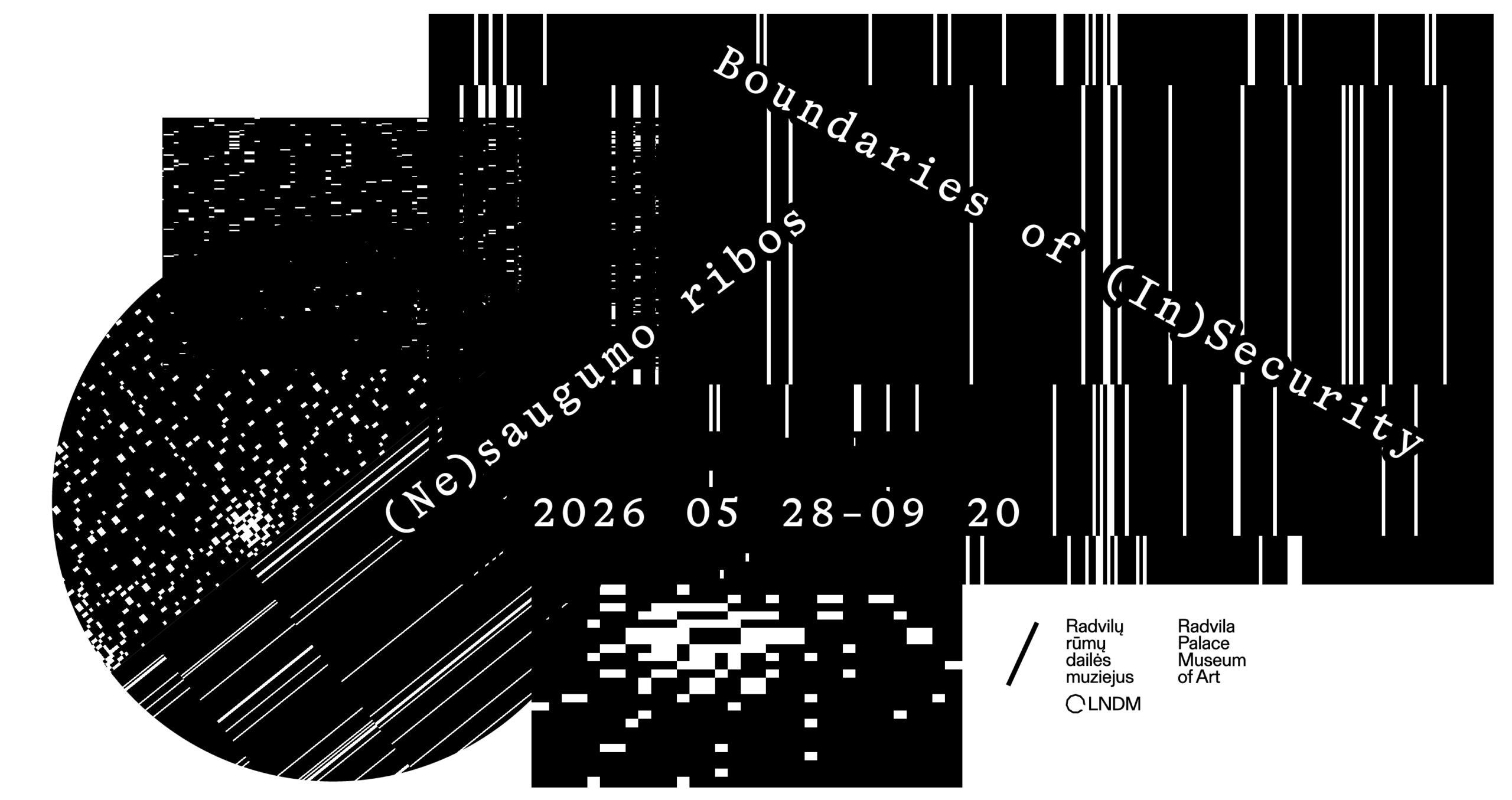
Boundaries of (In)Security
28 May – 20 September, 2026
 A contemporary human recognises that they can no longer expand freely upward, outward, or downward. A return to history is no longer possible, whether to grasp the conditions underlying our actions in this world, or to apprehend the nature of spatial conquests, explorations, and missteps (in Bruno Latour’s words, “we have all mutated without even realising it”). The authority of the present-day state is shaped by geopolitical forces operating both on the Earth and beyond it. At the same time, the meanings of invisible borders and signal-mediated personal security are becoming increasingly entangled. Real, though not always tangible geographical, meteorological, and national boundaries are becoming increasingly contaminated, as the digital order erodes the terrestrial one and exerts its influence equally upon the biological world and its various ethologies.
Since russia’s invasion of Ukraine in 2022, the world’s first large-scale drone war has surged into being, and so the sky, once a source of consolation in moments of existential anxiety, has imperceptibly transformed into a zone of threat. Social media channels, disrupted by waves of disinformation, often become the only (in)direct way to quickly make sense of the events during a conflict. Margarita Valionytė’s animation records the bewilderment of an observer during the first weeks of the full-scale invasion. The artist acutely felt the weight of news arriving from Ukraine on the day an unverified Telegram account began flooding with thousands of unread messages. The permeable infosphere and the propaganda that has been broadcast over radio airwaves are recalled by Kristina Inčiūraitė’s complex work, first presented a decade ago and now updated. The voice of a former spy recounting conspiracy theories is combined here with a Cold War radio telescope used to monitor foreign states, as well as with cosmic phantoms.
Military sabotage and attacks on electrical infrastructure across different countries prompt a reconsideration of the very concept of primary electricity generation. Mindaugas Gapševičius has constructed a set of electronic components designed to be worn on the body, capable of supplying a small amount of electrical energy. Personal electric current may be needed sooner than expected. Sky experts interviewed by Skaidra Trilupaitytė and Tomas Andrijauskas, drawing on personal experience and professional knowledge, reflect on the intangible objects of meteorological research, on Lithuania’s still-mild climate, and on national airspace. In measuring the distance to other celestial bodies, one eventually arrives at another ontological threshold, as illustrated by the ambitions of major powers in orbit in recent years. Matas Janušonis’s rubbed graphite work opens as a fissure in a colourless substance, through which thought presses toward an impenetrable darkness, a void that offers nothing to biological life. And yet, once the future severs all ties with the past, the fragile Latourian subject, having emerged from post-pandemic reality, attempts to move only forward. Whatever the consequences may be.
Skaidra Trilupaitytė
Curator: Skaidra Trilupaitytė
Artists: Mindaugas Gapševičius, Kristina Inčiūraitė, Matas Janušonis, Skaidra Trilupaitytė & Tomas Andrijauskas, Margarita Valionytė
Architect: Sigita Simona Paplauskaitė
Graphic designer: Marek Voida
Coordinator: Nojus Kiznis
Producing architect: Aleksandras Kavaliauskas
Translator: Raminta Bumbulytė
Organiser: The Radvila Palace Museum of Art of the LNMA
Project financed by: Ministry of Culture of the Republic of Lithuania
Special thanks to:
Vilnius Academy of Arts
- Purchase an e-ticket for this exhibition
- Book a guided tour of this exhibition by phone +370 616 16550, email radvilos.ekskursijos@lndm.lt
- Plan your visit to the Radvila Palace Museum of Art
Radvila Palace Museum of Art,
24 Vilniaus st, LT-01402, Vilnius, Lithuania
+370 5 250 5824