From an armoury into a culture space – the revival story of the Museum of Applied Arts and Design told by Danas Aleksa’s exhibition
Exhibition opening at 6 pm Thursday, 18 June, 2026

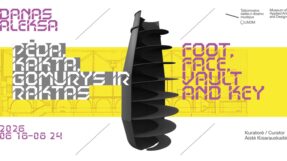
Thursday, 18th June, the Museum of Applied Arts and Design of the Lithuanian National Museum of Art (LNMA) (Arsenalo St 3A, Vilnius) opened Danas Aleksa’s solo exhibition Foot, Face, Vault and Key. The pivotal axis of the story is one of main historic armouries of the Grand Dutchy of Lithuania, which came to become a museum. The opening night invited guests to experience new sound and atmosphere of the historical space of the Old Arsenal, enhanced by a socially inclusive, immersive musical and spatial performance.
Džiuljeta Žiugždienė, director of the LNMA Museum of Applied Arts and Design, invites to the exhibition and its opening event: “Do not miss the opportunity to see this exhibition and take part in the opening performance, celebrating the creative cooperation of the artist Danas Aleksa and the well-known composer Snieguolė Dikčiūtė. The piece The Arsenal – the Cross-Sections of the Arch is about inclusivity of all social groups – professional artists, enthusiasts, and disabled people who discover their creative potential through an act of union, thus strengthening cultural dialogue.”
The golden ratio in a concrete mixer
To interpret the history of the museum building, the interdisciplinary artist Danas Aleksa employs the paradigm of the arch – one of the most ancient elements of architecture, which inspired engineering discoveries on the one hand, and came to symbolize military conquests and embody spiritual concepts on the other. Though the arch is rare in contemporary construction, and the terms used back in a day by the arch builders are forgotten, traces of the foot, the face and the vault are still visible in the architecture of the museum. The exhibition surrounded by the graceful curves of the historical arches, however, is not solely a story of the past. The concrete mixer – the robust energiser of the contemporary urban landscape, signalling expansion of construction by its constant presence on the roads, also plays a role of importance in the exhibition. The rotating concrete mixer’s drum reminds to the artist of the spiral of a seashell, it also associates with the golden section and with the Brutalist architecture, the creators of which transformed concrete structures into a distinct language of modernity.
“Personal details – cannon names – also reveal historic strata of the arsenal”, the artist says. “One of them had a name of “Vitold”, which, most likely, originates from “Vytautas”. There was another, called “Baba”. These names add some unexpected human aspect and another dimension to the story of the military past. In the contemporary narrative, the volumes of concrete mixer, which connect the historic war technology with the contemporary processes of artistic expression, become metaphors for the cannon.”
A shift from a weapons storage into a museum
The main key of the exhibition opens the history of the museum. The Museum of Applied Arts and Design is housed in the east wing of the Old Arsenal of the Lower Castle of Vilnius. In the 16th century, it was a residence of Elizabeth of Austria, and was transformed into the main arsenal of weapons and ammunition only later. Even much later, during soviet years, the half-ruined Renaissance building was occupied by soviet military. The year 1986 saw the building rebuild and adapted for the needs of the museum following the design by Evaldas Purlys. The architect restorer features as a protagonist of the exhibition. In a filmed interview, Purlys recalls the works of the reconstruction of the museum; he talks more of the building’s unique roof structure and introduces yet another architectural term of attica.
The exhibition curator Aistė Kisarauskaitė observes that the artist, revisiting and conceptualizing the transformation of the building, seems to addresses everyone living in troubled times, wishing that: “all weapon storages, which are used to threaten us or to defend ourselves, become places of peace and culture – the museums, while their vaults and basements stop being shelters to humans from foe’s attacks, but, instead, become homes for the rich collections of art.”
Darius Aleksa’s solo exhibition Foot, Face, Vault and Key runs until 24th August at the Museum of Applied Arts and Design. Information on events and education workshops inviting to learn a broader history of the museum through the exhibition is posted on the LNMA website and social media.
Curator Aistė Kisarauskaitė
Coordinator Mažvydas Truklickas
Composer Snieguolė Dikčiūtė
Sound design by Valdas Narkevičius
- Purchase an e-ticket for this exhibition
- Book a guided tour by phone +370 5 212 1813, +370 5 262 8080
- Plan your visit to the Museum of Applied Arts And Design
3A Arsenalo st, Vilnius, Lithuania
+370 5 212 1813;
+370 5 261 25 48; +370 5 262 80 80.
tddm@lndm.lt