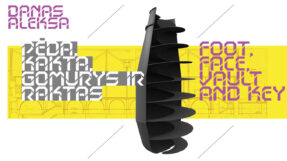
Danas Aleksa. Foot, Forehead, Vault and Key
18 June – 24 August, 2026
 This exhibition is a unified work by contemporary artist Dano Aleksa, interpreting the history, architecture, and construction of the Museum of Applied Arts and Design. It draws on specific terms, the main one being the arch. The arch is surrounded by the aura of engineering discoveries, military victories, and sacred buildings, and the curved forms of reconstructed arches can also be observed in the architecture of the exhibition hall itself.
Danas Aleksa reminds us that the foot, forehead, and palate are forgotten terms of the builders who once constructed arches, as arches have become a rarity in construction today. Instead, it is concrete mixers that matter now, and they also become an important part of the exhibition. They increasingly move through the city, blurring and expanding the boundaries of construction, becoming part of everyday urban life. The inside of a concrete mixer resembles a shell and a screw, golden ratios and brutalists who once sang odes to raw concrete at the top of their lungs—not with their voices, but through the architecture they created.
However, the key to the exhibition is the history of the Museum of Applied Arts and Design. It is located in the eastern wing of the Great Arsenal of the Lower Castle of Vilnius. Renaissance palace buildings were constructed on the Gothic defensive walls of the Lower Castle in the mid-16th century as the residence of King Sigismund Augustus’s wife, Queen Elisabeth of Habsburg. After her death, the Old Arsenal became one of the largest in the region and the main storage facility for weapons and ammunition in Lithuania, supplying armaments to all state fortresses. Even during the Soviet era, the partly demolished Renaissance building was occupied by Soviet military forces.
After the occupying army moved to Žirmūnai, the building was restored in 1986 and adapted for museum use, based on a project by architect Evaldas Purlys. Purlis also participates in the exhibition. In a filmed interview, he talks about the construction process of the Museum of Applied Arts and Design, recalls the distinctive roof structure of the museum, and introduces another architectural term—the attic (top storey). After reconstruction, the museum opened its doors in this building.
Thus, the shift from an arms depot to a museum is the core of this exhibition—the artist’s wish, in our turbulent times, that weapon depots threatening us and meant for defense would become places of peace and culture—museums whose arches and vaults will protect not against enemy attacks, but instead safeguard rich collections of art.
Aistė Kisarauskaitė
Curator Aistė Kisarauskaitė
Coordinator Mažvydas Truklickas
Composer Snieguolė Dikčiūtė
Sound design Valdas Narkevičius
- Purchase an e-ticket for this exhibition
- Book a guided tour by phone +370 5 212 1813, +370 5 262 8080
- Plan your visit to the Museum of Applied Arts And Design
3A Arsenalo st, Vilnius, Lithuania
+370 5 212 1813;
+370 5 261 25 48; +370 5 262 80 80.
tddm@lndm.lt