Vilnius hosts an international academic conference on artworks and their doubles: copies, imitations, and forgeries
14–16 October, 2026
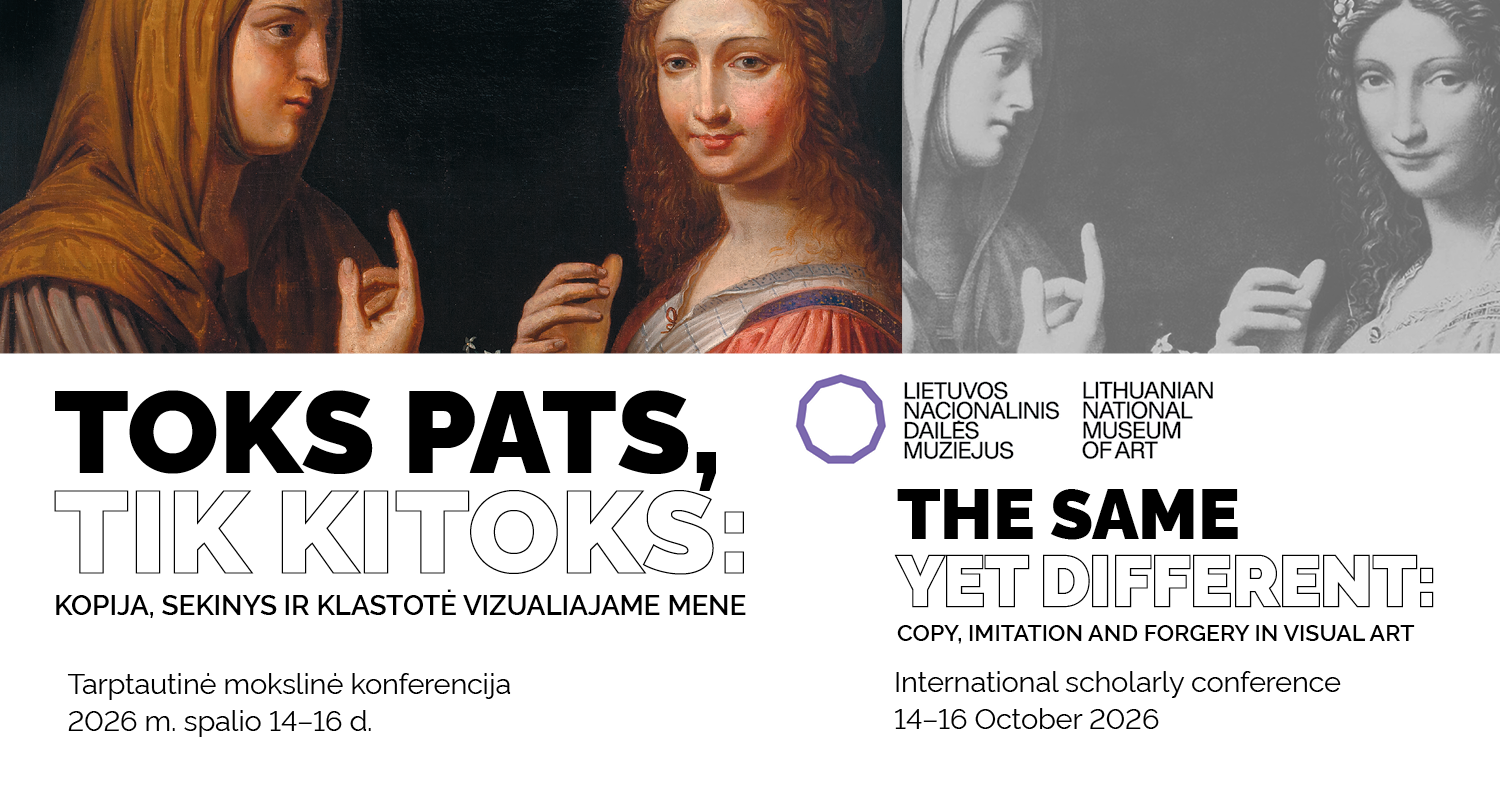 From 14 to 16 October, the Vilnius Picture Gallery (Didžioji St 4) of the Lithuanian National Museum of Art (LNMA) holds an academic conference titled The Same Yet Different: Copy, Imitation, and Forgery in Visual Art. The event brings together 36 researchers and specialists representing museums, universities, academies, libraries, research institutes and conservation centres across Lithuania, Latvia, Estonia, Poland, Italy, Germany, and Ukraine. Together they will explore the complex and diverse roles a copy can assume as a tool of artistic training, a derivative of a sacred image, an aid in conservation, a replacement for fragile works no longer suitable for public display, occasionally, an instrument of propaganda, or an intentional forgery.
The programme of the conference spans a vast period from Ancient Egypt to the Soviet era, and contemporary digital platforms. One of the central reference points of the event is a painting currently on display at the Vilnius Picture Gallery: The Taking of Christ after Caravaggio from the Odesa Museum of Western and Eastern Art, attributed to artistic circles in Rome during the first half of the 17th century. According to one of the event organizers, Dr Aistė Bimbirytė, Director of the Vilnius Picture Gallery, “The question of the authorship surrounding this painting – which keeps reemerging despite intensive research – underscores the relevance of our theme. Copies and forgeries, which are not always one and the same, are part and parcel of daily work by museologists, conservators, art researchers, and art market actors. At the Vilnius Picture Gallery, we also experienced the joyful discovery of a previously unnoticed signature, only to face disappointment when it turned out to be forged, and the reverse – an artwork held to be a copy for many years, turned out to be an original.
Copying in art is as ancient as art itself. While it was a common and encouraged practice in the Middle Ages, over time, copying also became a technique of deception. Misattribution of authorship is not always the result of an intentional forgery, yet, there are multiple cases that point to a seemingly endless resourcefulness in falsification. Copyists of Hieronymus Bosch’s paintings smoke-aged their works over chimneys to create an antique patina. Luca Giordano was acquitted by the court regarding his own painting, which bore a forged Albrecht Dürer monogram alongside his own hidden signature; the court concluded that since his skill matched Dürer’s, there were no grounds for indictment. In the 20th century, Han van Meegeren, who painted “newly discovered” Vermeers, managed to trick not only art connoisseurs, but also Hermann Göring. These stories, among others, serve as a reminder that the boundary between the original, copy, and forgery is rarely simple to draw. Quite frequently efforts to establish the true authorship of a work are the most exciting part of our job.”
The true authorship, creation context, and the history of conservation of The Taking of Christ have preoccupied scholars for decades. In search for answers, the painting underwent an X-ray, ultraviolet and infrared examination at the Pranas Gudynas Conservation Centre. The methods revealed work’s underlying structure, compositional changes made in the process of painting, subsequent overpainting, and traces of past restorations. Tomas Ručys, a researcher and specialist restorer at the centre, will present the conclusions drawn from this multispectral imaging. How effective is such technology in solving the lingering riddle of authorship? Beyond the technical examination, participating scholars and researchers will debate the broader phenomenon of the copy across art history, archaeology, art market, philosophy, and digital culture.
When is a copy not inferior to the original?
The conference will open with a plenary paper by Dr Alexander Röstel, curator of Staatliche Museen zu Berlin (SMB), titled Beyond the Original. Repetition, Replication, and Reinvention: Perspectives from Berlin. Drawing on the Berlin’s public collections – from copies of Roman sculptures to contemporary art – Dr Röstel will argue for a broader perspective of the copy beyond a mere substitute. Instead, a copy can restore the lost unity of a work of art, promote artistic ideas, shape museum collections, or inspire entirely new creations.
Researchers from Vilnius University will further demonstrate that replicas in past eras were not necessarily considered inferior. Dr Tomas Riklius from the Philology Department will discuss copies of sacred images which preserved the tradition of recognizable sacred representations and their religious meaning, thus holding authenticity in their own right. Meanwhile, art historian Dr Irena Vaišvilaitė will focus on Szymon Czechowicz and Franciszek Smuglewicz, whose artistic practice abounded in copies, derivatives, and paraphrases. Far from undermining these artists’ authority, these practices often contributed to their lasting prestige. Finally, replicas are indispensable when fragile originals cannot withstand a public display. Austėja Janušaitė, a student of the Vilnius Academy of Art, working with the Pranas Gudynas Conservation Centre, will present a reproduction of a silk wedding dress to illustrate its silhouette and construction while protecting the fragile original.
Original or fake?
The boundary between the original, replica and simulant can sometimes be traced only in a laboratory. Dr Rasa Gliebutė, senior archaeologist of The National Museum – Palace of the Grand Dukes of Lithuania, and Violeta Kisielienė from the Lithuanian Assay Office will present cases of gemstone simulants found among archaeological 15th –17th–century jewellery, including rings featuring doublets and glass crafted to imitate turquoise and ruby. Even today, these affordable imitations are difficult to identify at first glance.
Yet, in-depth laboratory examination occasionally fails to clear all uncertainty. Egyptologist Asta Junevičienė will address the challenges in establishing the authenticity of ancient Egyptian artefacts. Over millennia, styles from earlier eras repeatedly resurfaced, and sculptures of the ancient rulers were repurposed for new pharaohs through altered inscriptions, modified details, or reworked faces. At what point does a series of adaptations stop the artefact from being considered an original? The 19th- and 20th- century wave of “Egyptomania” further complicated the issue: as the demand for antiquities soared, convincing forgeries have found their way into major museum collections as authentic ancient treasures.
The contemporary art market is similarly plagued by uncertainties over provenance. Art market expert Dr Simona, Skaisgirė founder of Vilnius Auction, will highlight key red flags indicating that an artwork warrants closer scrutiny: convoluted history, missing documentation, stylistic discrepancies, suspicious signatures, later inscriptions, visible traces of restoration, or even a family lore. In such cases, determining authenticity depends not on a single piece of evidence, but on the totality of these signs alongside expert consensus.
The travels of images and their changing meanings
Copies have long enabled images circulate across borders – and, in relocating from one environment into another, assume a new purpose or meaning. Throughout the 17th and 18th centuries, engravings served as the primary vehicle for transmitting of international motifs and compositions to local artists. Dr Vija Strupule, a researcher at the Institute of Art History of the Latvian Academy of Art will illustrate this processes through interior wall paintings in Riga inspired by European engravings, biblical illustrations, and ornamental pattern books, showing how local artists adapted these compositions to fit specific spaces and client expectations.
When relocated, images could also take on new political connotations. Aleksandra Murre, Director of the Kadriorg Art Museum, will demonstrate how the motifs, originally created to glorify Louis XIV were incorporated into the ceiling decorations of Kadriorg Palace as part of visual narrative celebrating Peter I’s rule and military conquests.
The political dimension of 20th-century copies will be analysed by Indrė Urbelytė, a PhD candidate at the Lithuanian Culture Research Institute. In the early Soviet period, copies of selected paintings were created for the museum collections across the Lithuanian SSR not only to expand their holdings, but to train artists in the conventions of Soviet Realism. In travelling exhibitions, these copies served as ideological tools to reach broader audiences.
Today, images and their copies circulate instantly across digital platforms – from screen to screen in a heartbeat. Milena Černiakaitė, a PhD candidate at the Institute of Art Research at the Vilnius Academy of Arts, will discuss how social media reshapes artistic creation and circulation through Jaako Pallasvuo’s Instagram account avocado_ibuprofen. Here, “the follower” takes on a dual meaning: while the audience follows the artist, the artist in turn becomes a follower of the algorithm.
The programme of the conference The Same Yet Different: Copy, Imitation, and Forgery in Visual Art bridges millennia of art history art with contemporary digital culture. The conference is free and open to public, presentations will be given in Lithuanian and English, with simultaneous translation. The full three-day schedule is available on the LNMA website.
4 Didžioji st, Vilnius, Lithuania
+370 5 261 1685
vpg@lndm.lt