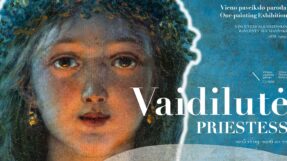
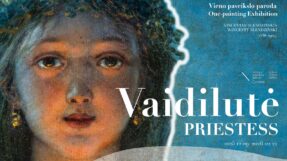
Before opening up the expanse of the legacy by Sleńdziński, the Vilnius Picture Gallery invites for a rendezvous with his Priestess

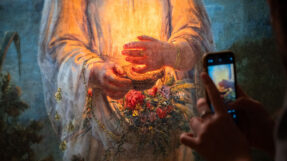
The Priestess by Wincenty Sleńdziński, currently on its first ever public display in Lithuania at the Vilnius Picture Gallery of the Lithuanian National Museum of Art (LNMA), is still available for viewing until 22nd February as one-painting exhibition. The artwork arrived in Lithuania from Poland thanks to the efforts of the art collectors Dominykas Šaudys and Regina Šemiotaitė. A special installation has been designed to showcase this unique piece: the painting, set in a glass wall supported by a concrete foundation and surrounded by a white drapery, seems to float in the feathery cirrus clouds. In this special space, the Priestess meets her visitors, who will be offered, this spring, a new exhibition titled With Heart and Eyes: Wincenty Sleńdziński, (1838–1909), presenting a broader panorama of the artist’s legacy.
The light of the Priestess takes by surprise the seekers of art mysteries

Both of the collectors, Dominykas Šaudys, a graduate of archaeology studies, and Regina Šemiotaitė, who has studied the history of art, are thrilles by the process of discovering art pieces, which, according to Šemiotaitė, require efforts to find. Over time, the couple’s shared field of interest zeroed in on 19th-century-Lithuanian artwork which is not only scattered the world over, but often also shrouded by mysteries. According to Šaudys, the emergence of such a piece requires substantial collection of evidence, which involves looking for signatures, technical examination, infra-red photography and X-ray analysis, consultations with the art historians until the artwork’s provenance and authorship are painstaking brought to light.
The encounter with this painting came as a surprise to the collectors. “We have received a proposal alongside with the images of such a poor quality that is was impossible to distinguish whether it was a genuine work or a good piece of forgery,” tells the story Šaudys. The process of the acquisition, adds Šemiotaitė, has been quite stressful and required a lot of patience, making put up with the unknowns for a long stretch of time. The situation was further complicated when the Galeria im. Sleńdzińskich in Białystok stepped in triggering a price competition of sorts. It took several months to reach the final solution.
When the collectors first saw the shining canvas in Poland, it was in a humble farm building. Šemiotaitė recalls that the painting was kept in a shabby, nearly uninhabited place. “When we arrived to the priest’s homestead, the painting was kept in what seemed like a shed. Yet even in these poor surroundings it looked so splendid, simply magical. We opened the door and were awestruck by what we saw, and knew on the spot what a great treasure we discovered,” Šemiotaitė shares the exciting discovery story.
The journey of the painting, and the aura of Lithuanian spirit
Wincenty Sleńdziński painted the Priestess in 1873, in Dresden, Germany. From the artist’s studio, it made for the collection of the counts Kwilecki and was displayed at the Grodziec estate manor in Poland, as attested by the extant inscription on the reverse of the canvas. Later on, the painting passed into the care of the canon of the Grodziec parish, while in the early 1970s, it was acquired by Father Wojciech Krzywański. Around that time, the artist’s son, Ludomir Sleńdziński got interested in the painting. He tried, a couple of times, to acquire the canvas, offering, in exchange, three of his own works, but in vain. The priest safeguarded the Priestess for over five decades, and only when he reached a very senior age, did he decide to part with the picture.
“It was very touching that he pledged a part of the profits to the church and the community, it is heartwarming, when some of the proceeds are put to such a good end,” Šaudys says.
The period of the creation of the painting is also of significance to the collectors, as the artworks Sleńdziński produced in Dresden, are exceptionally rare according to them. Created outside Lithuania, the Priestess is, nevertheless, filled with Lithuanian spirit: the owners of the work relate the protagonist of the painting with Birutė, the wife of Kęstutis, the Grand Duke of Lithuania. The assumption is derived from the fact that the face of the Priestess has a close similarity to the likeness of Birutė in another work by Sleńdziński, Kęstutis Abducting Birutė. According to Šaudys, they pride themselves on the fact of having a painting from such a rare period, related to the spiritual heritage of Lithuania. The powerful emotional impact of the painting emerges in the words of the guides of the Vilnius Picture Gallery, who witness the visitors moved to tears in front of the Priestess.
“The painting captivates by reaching to the very roots of everything Lithuanian, that is why it so easy to identify with this image,” says Šemiotaitė.
The painting brought back to its brilliance, and another surprise awaiting the Gallery’s visitors
The collectors have entrusted the painting to the restorer Linas Lukoševičius. Šaudys describes how the removal of the layers of varnish, the one darkened over 150 years, and the new one, applied in the mid-20th century, has revealed details of the painting, a silhouette of a castle and the subtle nuancing of light. Alongside with the painting, the frame designed for this particular work, has also been conserved and restored, the process supervised by the restorer Virginia Murmaitė. The condition of the frame was more problematic, as it was disintegrating at some places, calling into question the possibility of bringing it back to life. “Despite of it, the efforts have been successful, and we are very happy for it,” Šemiotaitė says.
The Priestess is not the first work of art by Sleńdziński acquired by the collectors, but according to Šaudys, it stands out through its singular significance. “As the artist’s son recognized this being his father’s finest, we do not feel in a position to contend the opinion”, he says. He is positive that had the work been in the collections of the museum from the mid-19th century, its significance to our culture would have been compared to such famed pieces as The Reaper by Kanutas Ruseckas or The Penitent St Mary Magdalene by Wladyslaw Niewiarowicz. The collector also mentions that shortly, early this March, they are about to present another newly acquired Sleńdziński’s artwork, arriving from Los Angeles, “Which is no lesser in significance and has an intriguing story”.
An exclusive rendezvous with the Priestess is still offered to the Gallery’s visitors until 22nd February; starting 3rd March, the painting will be presented as part of the exhibition With Heart and Eyes. Wincenty Sleńdziński (1838–1909).
4 Didžioji st, Vilnius, Lithuania
+370 5 261 1685
vpg@lndm.lt