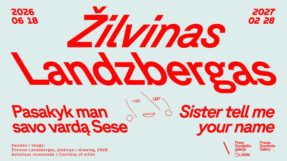
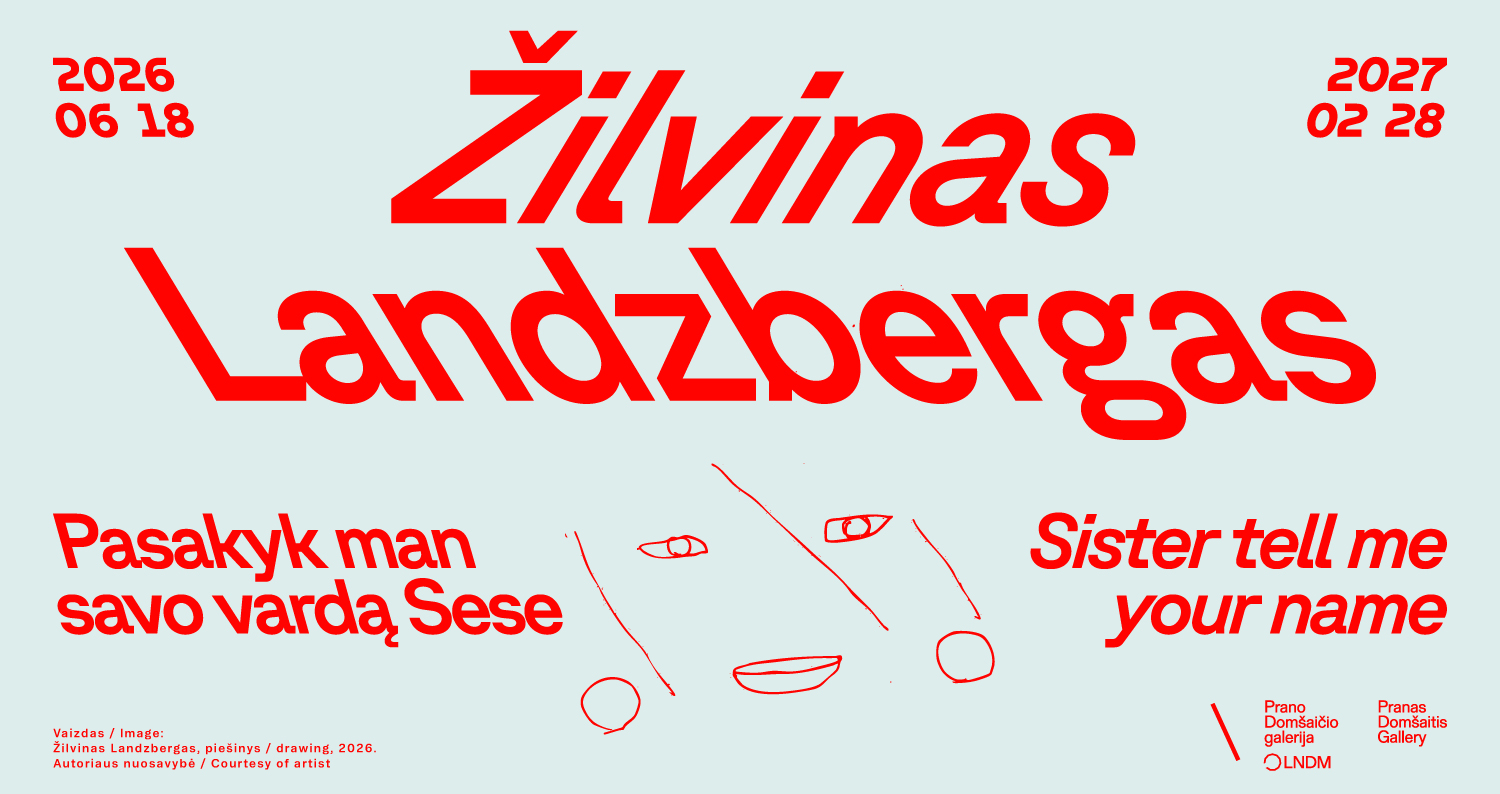
Sister tell me your name
18 June, 2026 – 28 February, 2027
 Žilvinas Landzbergas, born in 1979, is a renowned Lithuanian artist. He represented his country at the Venice Biennale in 2017 and has participated in many other international exhibitions, such as the São Paulo and Riga biennials in 2018. Trained as a sculptor at the Vilnius Academy of Arts, where he also teaches, and at the independent artists’ institute De Ateliers in Amsterdam, he is best known for his comprehensive installations. These typically combine sculptures and paintings and drawings, and sometimes also moving-image works, into immersive but always distinctly personal experiences for diverse audiences. Landzbergas also curates exhibitions with other artists. In 2011–2013 he ran his own exhibition space in Vilnius, Malonioji 6. He is represented by Meno parkas in Kaunas.
Landzbergas’s approach to the exhibition situation empowers both him, the author, and us, his viewers and participants. He envisions and constructs, suggests and guides. He strives for a total work of art, a Gesamtkunstwerk that emerges in the intersection of planning and improvisation, strategic and operational thinking, narrative and atmosphere. His exhibitions have an ‘analogue’, ‘hand-drawn’, ‘self-built’ feel, encouraging us to delve into his artistic vision and maybe even lose ourselves in it. At the same time they are situated – and they situate us – in a present moment that is almost always unclear, demanding and menacing. In other words, Landzbergas speaks to contemporary society in the voice of the artist-as-free-spirit, but also in the voice of the artist-as-social-conscience.
Dailininkas apipavidalintojas, the artist-designer who gives form to everyday life, is a concept from the Lithuanian twentieth century that still feels relevant, also to Landzbergas’s practice, and not least because he has long resisted the temptation to put the artist on a pedestal together with his work. In his socially engaged role, the artist takes on a responsibility for starting and maintaining dialogue, for convincing society about the value of his artistic vision. Today this is no longer an imposition from above to stick a human face to an inhuman regime, but an ethical approach to images and objects, spaces and audiences. It is a political but also time art-specific take on contemporary visual reality.
Like art institutions and the curators that programme them, the artist works with, for and through other people. He and his work need the viewers and participants to come alive. Landzbergas clearly plays with this interaction. He lowers the threshold for exhibition visitors and entices them to step into a microcosm of the surrounding reality, visually and emotionally enhanced to resemble a film set, a theatrical stage or a cabinet of curiosities. Here he has chosen what might first appear to be the opposite strategy. To enter this exhibition we need to get a key code from the museum’s reception.
Once inside we realise that everything is set up to resemble someone’s living space. Or is it a space for performing domestic life? The artist-designer has gone about this in a stylised and abstract way, as if he were looking for the most precise visual metaphors for ‘house’, ‘home’, ‘arena’ or ‘platform’. We are encouraged to imagined the ground floor of the museum inhabited by several generations of one extended nuclear family. Grandmother’s room is actually museum-like, with artworks on pedestals and on the walls. Father’s room is a work station and mother, it seems, is always in the kitchen.
Judging from the overall setup and from the exhibition title, the daughter is the main protagonist here. She is especially present on the round soft platform that we are invited to use. In fact Landzbergas says he created ‘Sister, tell me your name’ to emulate the treasure box that many young girls keep. You may be allowed to open the box and play with its contents, but only if you observe certain protocols of respect and politeness. This invites us to actively imagine vulnerability and consider people’s need – or actually their right – to be safe together. What would a family do at home on a day off? How would they hang out together? Sadly, in these times of war, no such convivial routine is self-evident or guaranteed anymore.
A T-shaped platform leads us from the last exhibition gallery out into the unexpectedly elegant garden, vaguely Japanese but unmistakably Northern European. Žilvinas Landzbergas wanted to incorporate it in the exhibition, so he installed his own hothouse tower there. We exit the garden and the exhibition through a door that leads us back to the street through the reception.
Anders Kreuger
Curator: Anders Kreuger
Editor: Ilona Čiužauskaitė
Design: Eglė Kirlytė
Soundtrack: Dominykas Digimas
Media Partners: JCDecaux, Delfi
- Purchase an e-ticket for this exhibition
- Book a guided tour of this exhibition by phone +370 46 410 421, email domsaicio.edukacija@lndm.lt
- Plan your visit to the Pranas Domšaitis Gallery
33 Liepu st, LT-92145, Klaipėda, Lithuania
+370 46 410 412
domsaicio.galerija@lndm.lt