Exhibition "Forever young! Polands and its art around 1900"
29 October 2015 – 31 January 2016
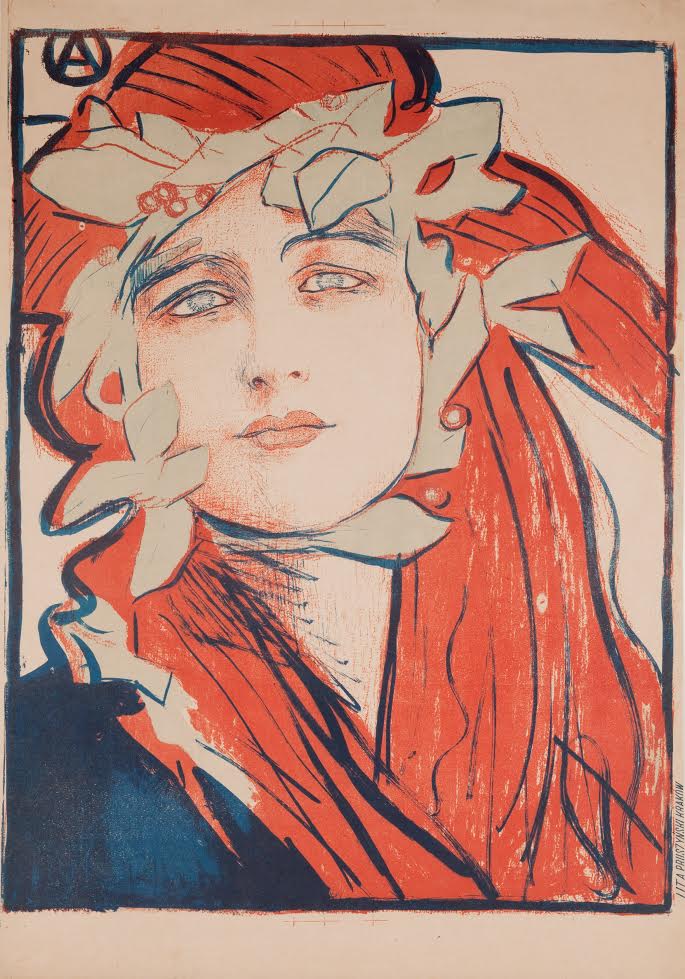
Teodor Axentowicz (1859-1938). The second exhibition of Polish artists society „Sztuka“, 1898
The exposition is a part of the presentation of the traveling exhibition which was held in 2012 by the National Museum in Kraków and the title of the Exhibition is very expressive – “Forever young! Poland and its art around 1900”. The Exhibition is dedicated to the art of “Young Poland” period; this period does not lose the interest until now.
Kraków was the cradle of art and the most active core in these days, the centre of more active intellectual and artistic activities. This was a place where the new Art was born which focused on revaluation of philosophical-cultural values at the turn of the 19th and 20th centuries, the Art Education Reform, the emergence of societies of new independent artists; the Art which focused not only on the overstatement of the achievements of predecessors, the openness to new influences, but also on the extensive range of artistic activities and attitudes. In addition to a strong desire to be independent, we see the attempts of this Art to identify distinctive features that highlight the national identity. Despite apathy and disorder brought at the end of 19th century, we can see the dynamic vitality of the events in the Art of “Young Poland”. In those days, the artists, having chosen the right to freedom, individuality and subjectivity, desired to create works that were independent from strict provisions valid for these times. The artists asserted that they rendered the state of mind, moods, and emotions with the help of art and liberated it from the official purpose. In their purposes, the artists rendered different artistic approach to the form and developed the craft that reflected the works in different styles and they were united by the prevailed symbolist vision and perception which resulted in an ambiguous idea of the work.
At the turn of the century the National Museum in Kraków experienced dynamic expansion, it accumulated contemporary fine arts from the very beginning and even then the Museum acquired one of the most numerous and most interesting collection of “Young Poland” artworks, so almost all of the exhibits are displayed from this rich collection. It goes without saying that most of the authors whose works are presented were of Kraków descent, although the works of the artists who come from other regions are also not missing. We will exhibit the paintings of Olga Boznańska, Julian Fałat, Aleksander Gierymski, Konrad Krzyżanowski, Jacek Malczewski, Józef Mehoffer, Władysław Podkowiński, Ferdynand Ruszczyc, Jan Stanisławski, Włodzimierz Tetmajer, Wojciech Weiss, Witold Wojtkiewicz, Leon Wyczółkowski, several sculptures created by Ksawera Dunikowska, Konstanty Laszczka and Wacław Szymanowski, we will also introduce the works of Polish Masters in Engraving and Graphic Arts created by Konstanty Brandel, Charles Frycz, Józef Mehoffer, Józef Pankiewicz, Władysław Skoczylas, Jan Stanisławski, Wojciech Weiss, Witold Wojtkiewicz, Leon Wyczółkowski and others, and we will present the best examples of Applied Art.
All the Exhibition Halls in Vilnius are devoted to specific themes that are very important for “Young Poland” Art and presented in the same way as in the exposition in Kraków. The Exhibition begins in the Hall of Kraków Townscapes dominated by beautiful and thoughtful landscapes that are important not only for Kraków citizens: Wawel, a symbol of Polishness, the Market Square, the Boulevard (Planty) and the Churches. Kraków was the city which cherished the history, preserved the recollection of famous Poles, and played a role of the patriotic centre influencing all lands of partitioned Poland. In addition to these images we also present the glorious face of the city which is less publicized, i.e. a playful, artistic image of the city which was created in the theatre, cabaret, shown in caricatures, mostly drawn by the younger generation of Kraków bohemians.
The other space is dedicated to the artists themselves and their models. During the period of “Young Poland” the art of Portrait and Self-portrait newly flourished which most clearly reflected artistic goals until the above-mentioned period, and during these times. Despite varied style and changing composition, the common feature of these images was emphatically psychologised rendering of models, sometimes using different symbols.
The exhibition perfectly reflects another theme important for the art of “Young Poland” – the landscape which sometimes is inspired by the achievements of Impressionism and rarely purely realistic, however, the landscape is usually marked by symbolism or expression that defines the artist’s state of mind and forcibly affects the viewer. In the Hall our attention is drawn by the artworks of Pankiewicz, Ruszczyc, Stanisławski, Wyczółkowski and the so-called landscape school of young artists formatted by Stanisławski.
It is not a coincidence that the art of “Young Poland” is associated with symbolism, the ability to render additional, concealed meanings, moods and emotions. Therefore, the Hall dedicated for such purposes presents various semantically “saturated” works enriched by decadence and symbolism or sometimes by literary and fantastic references, seeking to render evocative atmosphere related to the issues such as eroticism, death, nationality.
In another space of the Exhibition the folk theme is highlighted that distinguishes the art of “Young Poland” in the European creativity background of these times. The interest in people and culture was associated then to the neo-romantic perception of rural environment where the elements of national identity were best preserved. Furthermore, the artists were attracted by colourfulness and imagery of rural customs and clothing which they portrayed both in realistic manner and decoratively stylized.
The last Hall is dedicated to the works of applied art: prints, textiles, ceramics and metal crafts.Among the exhibits there are the works inspired by European Secession, Japonism, and Polish folk motifs.
The exhibition is complemented by facsimiles of “Young Poland” posters. Before the end of the 19th century Polish artistic poster was found namely in Kraków that advertised the events of artistic life. Great stylistic diversity and high artistic level was determined by their designs created by famous artists.
Krystyna Kulig-Janarek
Exhibiton organizers: General sponsor:


Sponsors: Media sponsors:


4 Didžioji st, Vilnius, Lithuania
+370 5 261 1685
vpg@lndm.lt