A new exhibition at Vytautas Kasiulis Museum of Art – about the body, material and indefiniteness
Exhibition opening at 6 pm Thursday, 29 January, 2026
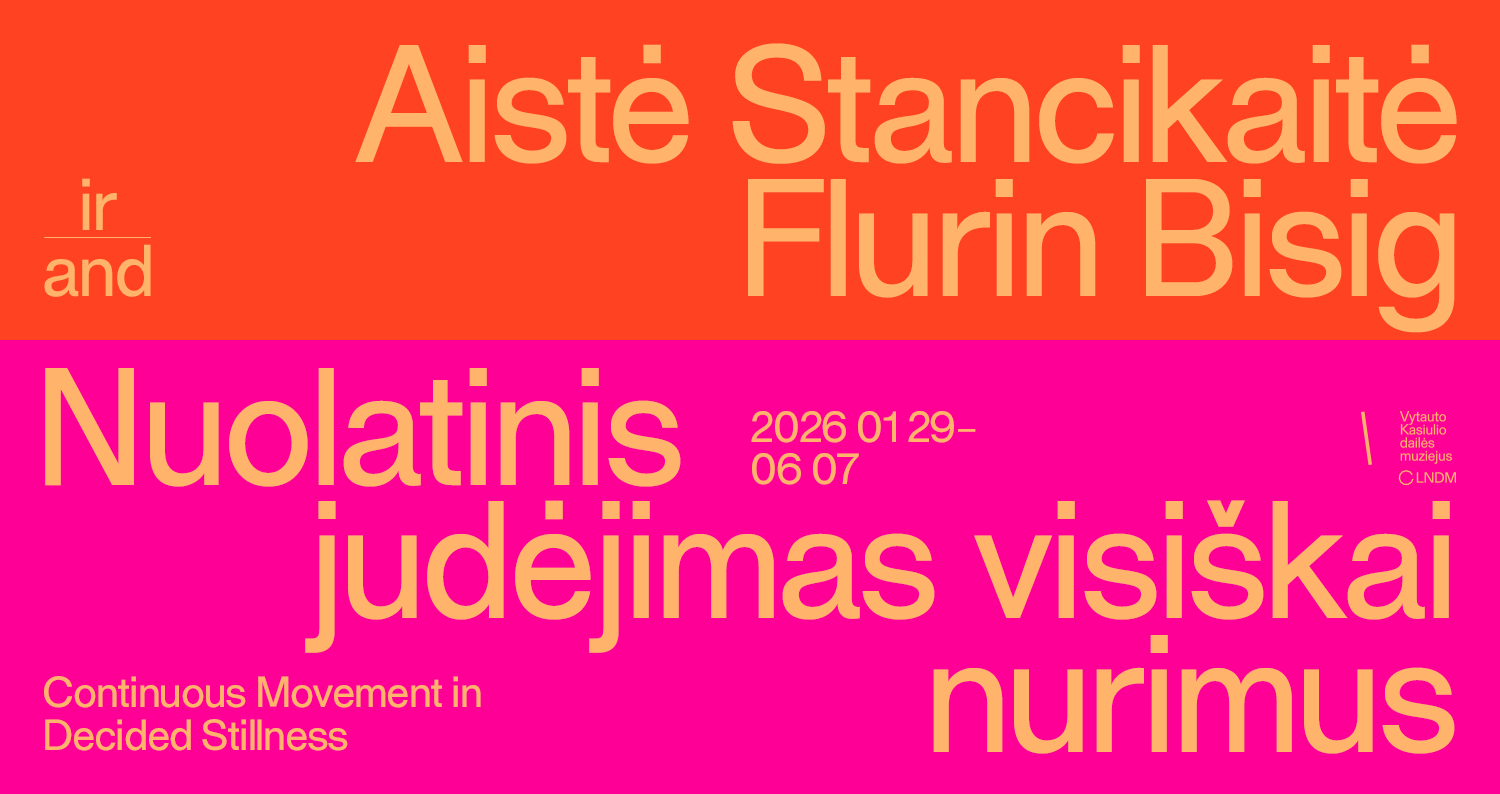 Thursday, 29 January, at 6 pm, Vytautas Kasiulis Museum of Art of the Lithuanian National Museum of Art (LNMA) opens an international exhibition Continuous Movement in Decided Stillness, a visual dialogue between Berlin-based-Lithuanian artist Aistė Stancikaitė and the Swiss artist Flurin Bisig. Their artwork displayed together enact an encounter of movement, wonder and surrender of the idea of ever really getting to know oneself and the world.
The Vytautas Kasiulis Museum of Art of the LNMA consistently engages in a dialogue with the history of art of the diaspora, on the other hand, the museum gives floor to the prominent voices of the living artists and their present-day communications.
“For us it is a way to maintain the dynamism of the museum and to ensure we talk contemporary language, remaining at the same time aware of the longstanding tradition of migrating art, an antidote to getting stuck within established boundaries,” according to the museum director Ilona Mažeikienė.
Zippora Elders, an internationally acclaimed art researcher behind the concept of the event, explains the solution to present these particular artists as a duo:
“Poetically speaking, Bisig seems to come from the past, combining canonical elements with personal passions, in search of guidance on how to approach the present. At the same time, he knows his technical and historical principles very well. Stancikaitė, then, maybe comes from the future, with references of the unknown and science fiction.”
Aistė Stancikaitė and the figures in conflict with categories
Aistė Stancikaitė’s practice engages with the questions of identity, desire, and the fluidity of gender and sexuality. Recurrent fragments of obscured figures and fetish-inflected imagery populate the multilayered surfaces of her paintings and drawings, connecting into fragile, continuously morphing visual structures poised between reality and fantasy, the human and artificial. The artist draws from theoretical frameworks informed by Judith Butler, Donna Haraway, and Carl Jung, yet no less powerfully her art is shaped by her personal vision. The artist says she is never perceiving the world as an entirety, but rather as a sequence of details, fragments, cuttings that carry more meaning than a complete totality. This interrupted character of perception reflects on her protagonists, the creatures escaping categories and definitions, described by the artist as “non-belongers”.
“They fit nowhere: they are abstract, fluid and exist in liminal spaces. They have no fixed identity, there is no group they clearly connect to. The viewers try to guess who they are, where they come from or whom they represent. Yet there is never one answer. This type of ambiguity shuns binary mentality and categorization in general,” says the artist.
Flurin Bisig and his exchanges with marble via form
Flurin Bisig, born in Switzerland where he currently lives and works, in his practice embraces sculpture, drawing, collage and photography, all these different visual languages for the artist spring from one source: a quiet, internal impulse. This state of mind is the nourishing soil from which his particular connection with material grows. Especially with marble, which for Bisig is not inanimate rock, but a companion engaging in a conversation on equal terms. “Marble is considered “eternal”, but it erodes, cracks, and bears traces. This paradox fascinates me: something so hard can also be vulnerable. Just like ourselves,” says the artist.
The process of sculpting to him is about focusing and listening to his material, his solutions are equally dictated by the stone. The artist describes this experience as akin to music. Even a fracture becomes a continuation of the process, when a fractured part is bound again to the whole, an imperfection integrated into the structure of the emerging work of art. Bisig prefers abstract sculpture, derived from a fundamental drawing basis, while sculpting marble is a way to revisit the heritage of classical sculpture. The drawings and collages emerging alongside with the objects in the round are part of the same conceptual field and the same effort to grasp the form before it is set.
The exhibition stages the artwork as a dialogue by the artists on a par with each other, representing different yet convergent strategies. According to Zippora Elders, this encounter reveals also their shared creative interests: “The practice by both artists is primarily concerned with the relations of the body and the human. The obviously solitary figures pursue different truths while escaping the norms: in the art and life. In terms of geography and energetics, this exhibition for Stancikaitė is a homecoming, and for Bisig – an unexplored territory.”
With the Continuous Movement in Decided Stillness, the creative team with international experience makes its first appearance of to the Lithuanian viewer. The exhibition will be on until the 7th of June and will be accompanied by tours, lectures and other events. Event information is available on the LNMA website and social media.
The museum extends its gratitude to the project partner GNYP Gallery and the sponsor of the event, the Embassy of Switzerland to Latvia, Lithuania and Estonia.
Exhibition concept by Zippora Elders
Architecture concept by RESH
Designer Jurgis Griškevičius
Coordinator Birutė Pankūnaitė
Copy editor Ieva Puluikienė
Translator Aleksandra Fominaitė
Organiser Vytautas Kasiulis Museum of Art of the LNMA
Partner GNYP Gallery
Sponsor Embassy of Switzerland to Latvia, Lithuania and Estonia
- Purchase an e-ticket for this exhibition
- Book a guided tour of this exhibition by phone +370 5 243 1138, +370 5 261 6764, email juste.januleviciute@lndm.lt
- Plan your visit to the Vytautas Kasiulis Museum of Art
1 Goštauto st, Vilnius, Lithuania
+370 5 261 6764.
kasiulio.muziejus@lndm.lt