Margarita Čepukienė. Procession Banners
21 February - 9 April 2017. Opening 21 February, 4 p.m.
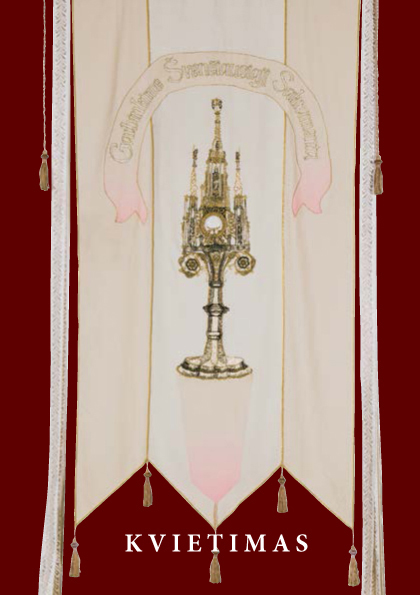
The exhibition Procession Banners represents a creative report of two-decade work by the artist Margarita Čepukienė. The first exhibition of banners was held in 1995, at Mykolas Žilinskas Art Gallery in Kaunas, the current one is dedicated to the artist’s jubilee that commands true respect. Alongside with the double-sided liturgical banners, on display are also the banners in smaller sizes belonging to different educational and other institutions. The exhibition features 23 banners, most of which belong to Vilnius Cathedral Basilica, the rest are the property of the parishes of Kražiai, Šiluva, Druskininkai, Obeliai, Labanoras, Kamajai and others.
Born in a little town of Gaurė in the county of Tauragė, Margarita Čepukienė learned the foundations of art during the hard post-war times. Her father was deported to Siberia, while Margarita and other family members had to hide to avoid the same fate. For a while she lived in a nunnery of the Sisters of St Elizabeth and studied at Kaunas Secondary Art School. There the classes in water colour painting by Česlovas Kontrimas were the strongest formative influence on her future artistic path. In 1964, Čepukienė graduated from the Lithuanian State Institute of Art (now, Vilnius Academy of Arts) majoring in graphic arts. From 1966 through 1989 with intervals, she worked at the experimental artistic design bureau where, with other artists, she produced graphic designs for industries. In 1975 – 1977 the artist with her family lived in Cuba. During that time she painted water colours and gave two exhibitions at the city library of Santa Clara.
When in 1989, with the rise of the Independence movement Sąjūdis, the faithful returned to Vilnius Cathedral Basilica, Monsignor Kazimieras Vasiliauskas invited the artist to work for the Cathedral and commissioned a number of liturgical banners for the church. By 1998 she had created for the Cathedral ten banners in the same size, of different composition and of diverse colour schemes. The rectangular shapes of wool cloth bear resemblance to the traditional liturgical banners with their lower edge cut in shapes and finished in piping, tassels, strings, and manufactured ribbons. The two light coloured banners featuring an embroidered monstrance and the liturgical symbol of pelican are dedicated to the Holy Eucharist. They are juxtaposed by the dark openwork banners. The fields of the remaining banners feature characteristic liturgical colours: the greens, reds and blues, with the icons of the Blessed Virgin Mary and of other saints depicted against them. The apparels of the figures are done in appliqué by gathering and layering shiny synthetic materials, both smooth and textured, in diverse golden and silver hues. The appliqué technique is also used in faces and hands that are otherwise embroidered by hand. The artist dedicated her most thorough attention to the saints’ faces striving to cast them as figures of deep spirituality. She used dense stitching to model them in colour. The averse of the liturgical banners bear texts of religious content and appliqué decoration in floral motifs. The reverse of the banners is done in uncluttered compositions of the usual liturgical symbols, such like the cross, monograms, emblems and date of manufacturing.
When the church of Labanoras was lost to fire and reconstructed in 2009, the artist initially created an embroidered banner for the high altar of the new church. Later she created tapestry and appliqué textile pieces for the high and the side altars. Pictures of her works at the Church of Labanoras are included into the show.
The banners embroidered by the artist total at 57. Several of them were produced for the Ministry of the Interior of Lithuania (Police Academy, the Lithuanian Police and the Boarder Police) to the designs by the artist Romualdas Karpavičius. Čepukienė has also designed and realized banners for private individuals in Lithuania and abroad (for a couple of Biblical churches in Africa and for one in the USA). In 2017, she finished working on a banner that shows an embroidered and appliquéd figure of the Risen Christ against a white, thin and translucent fabric. It will not take long for this new work to find its place in a church of one of the parishes.
Nijolė Žilinskienė
3A Arsenalo st, Vilnius, Lithuania
+370 5 212 1813;
+370 5 261 25 48; +370 5 262 80 80.
tddm@lndm.lt