Greatness in Humility. Artistic elements of Japanese swords, prints and miniature sculpture
30 January – 20 April 2026
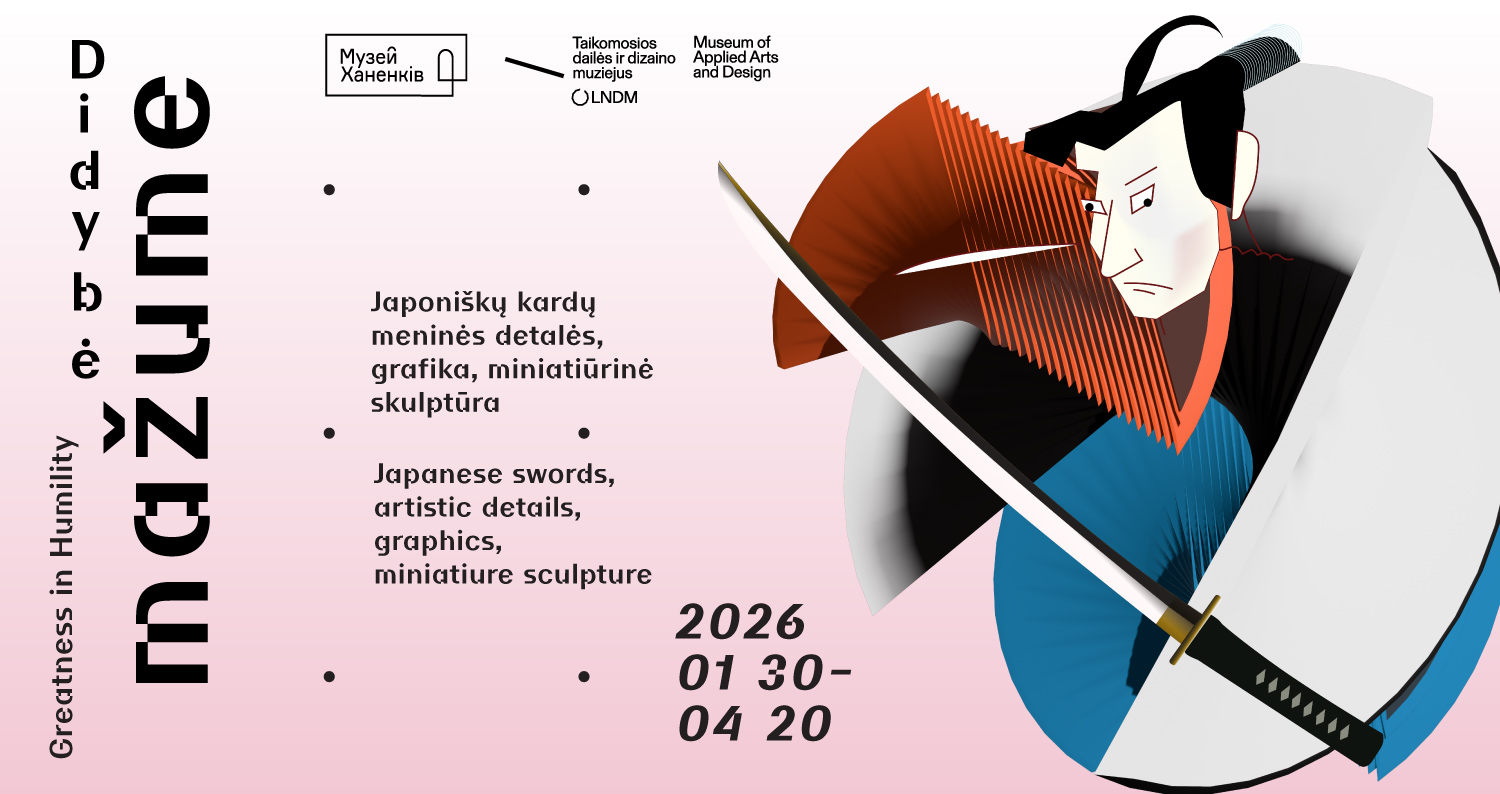 Japanese artworks from the Bohdan and Varvara Khanenko National Museum in Kiyv (Ukraine) reflect the material world of samurai in the Edo, or Tokugawa, period (1603–1868). For this exhibition at the Museum of Applied Art and Design in Vilnius, items from a collection of over seven hundred objects have been selected that best represent the art of sword decoration, the subtleties of woodblock printmaking, and the virtuosity of miniature sculptural forms.
The samurai were a special class in the Japanese military with similar virtues to European knights. They were a reflection of the values and ideals of the era that shaped them. The word “samurai” itself means “one who serves another”. The samurai were also known as bushi, or warriors. The noble warrior class emerged in premodern Japan’s most densely populated provinces at the beginning of the 10th century, eventually growing into a force that ruled the country from the 12th century until the Meiji Restoration in 1868. The main reason for the rise of the samurai was the decline of the central government in Kyoto, which was in the hands of the imperial court. The samurai became the authorised ocials responsible for provincial governance, primarily within courtier’s private dominions known as shoen and in religious institutions. The samurai class was usually led by descendants of the imperial family.
The collection of items on display reflects the Japanese notion of greatness in small things, where a miniature object embodies entire worlds – the social and material dimensions of ancient Japanese culture. The collection primarily consists of Japanese sword mountings and miniature sculptures known as netsuki. Melee weapons were an integral part of the Japanese armoury and were closely associated with the code of bushido, “the way of the warrior”, centred around the art of sword wielding. Favoured by townspeople, the netsuki became popular clothing accessories, first among Japanese men, and later women. They served as buttons, pendants, and counterweights for containers and pouches attached to one’s belt. These valued miniature sculptures not only served a functional purpose but also signalled individuality and status. Their beauty, perfection, and craftsmanship quickly made them a coveted collector’s item.
The set of exhibits is complemented by coloured Japanese xylographic prints representing the popular culture of Edo period Japanese cities. The images bring to life famous warriors, epic heroes, and kabuki theatre actors portraying samurai.
Coloured woodblock prints are a phenomenon that originated in the very heart of Japan, primarily in Edo, and flourished between the 17th and 20th century. The prints, commonly known as ukiyo-e (“images of the floating world”) evolved from early monochrome images into subtle hand-coloured prints, and eventually into luxurious multi-coloured sheets.
The creation of a single print involved an artist (who conceived the idea and the image), a blockcutter, a printer, and a publisher who was in charge of the funding and the entire process from discussing the contents to the nal release of the print for sale.
The exhibits oer a compelling testimony to the meticulous way in which the people of Japan nurtured even the smallest elements of existence at all levels of daily life.
Dr Sigita Bagužaitė-Talačkienė
Dr Olha Novikov
Project leaders:
Director General of the Lithuanian National Museum of Art Dr Arūnas Gelūnas
Director General of the Bohdan and Varvara Khanenko National Museum of Arts Julija Vaganova
Director of the Museum of Applied Arts and Design of the LNMA Džiuljeta Žiugždienė
Curators and coordinators: Sigita Bagužaitė-Talačkienė, Katerina Baranovska, Olha Hončarenko, Regina Makauskienė, Skaistis Mikulionis, Olha Novikova, Eglė Jagminė, Mažvydas Truklickas, Julijus Balčikonis, Julija Samailova, Anastasija Macelo
Architect Ūla Žebrauskaitė-Malinauskė
Designers: Marius Žalneravičius, Edita Namajūnienė
Projection Designer Vladas Balsys
Translators: Džiulija Elena Fedirkienė, Ruslanas Skrobačas
Copy Editor Ieva Puluikienė
Organisers: The Lithuanian National Museum of Art, The Bohdan and Varvara Khanenko National Museum of Arts in Kyiv
General Sponsor Novalda stiklai
Main Sponsor GlasLT
Sponsors: UAB AD Rem, CLS Brokerage Company, UAB Bunasta, UAB Nova Post Lithuania, BTA
Patron Honorary Consul of the Republic of Lithuania in the Luhansk Region Robertas Gabulas
Conservators: Rasa Bieliauskaitė-Mikolaitienė, Rimvydas Derkintis, Paulius Zovė
Special thanks to:
Ambassador Valdemaras Sarapinas
Ambassador Inga Stanytė-Toločkienė
Ambassador Olha Nikitchenko
Valdas Dovydėnas, Tadas Gečauskas, Rita Grochovskienė, Tomas Ivanauskas, Giedrius Jackūnas, Renata Kanarskaja, Romas Klapatauskas, Mirijana Kozak, Narimantas Savickas, Vladimiras Ševerdovas, Darius Zaura, Andrius Šulskis, Povilas Ruškus, Agata Voleiko, Serhij Burlačenko, Liubomyr Demjančiuk, Lesia Rožak, Andrij Černeha
- Purchase an e-ticket for this exhibition
- Book a guided tour by phone +370 5 212 1813, +370 5 262 8080
- Plan your visit to the Museum of Applied Arts And Design
3A Arsenalo st, Vilnius, Lithuania
+370 5 212 1813;
+370 5 261 25 48; +370 5 262 80 80.
tddm@lndm.lt