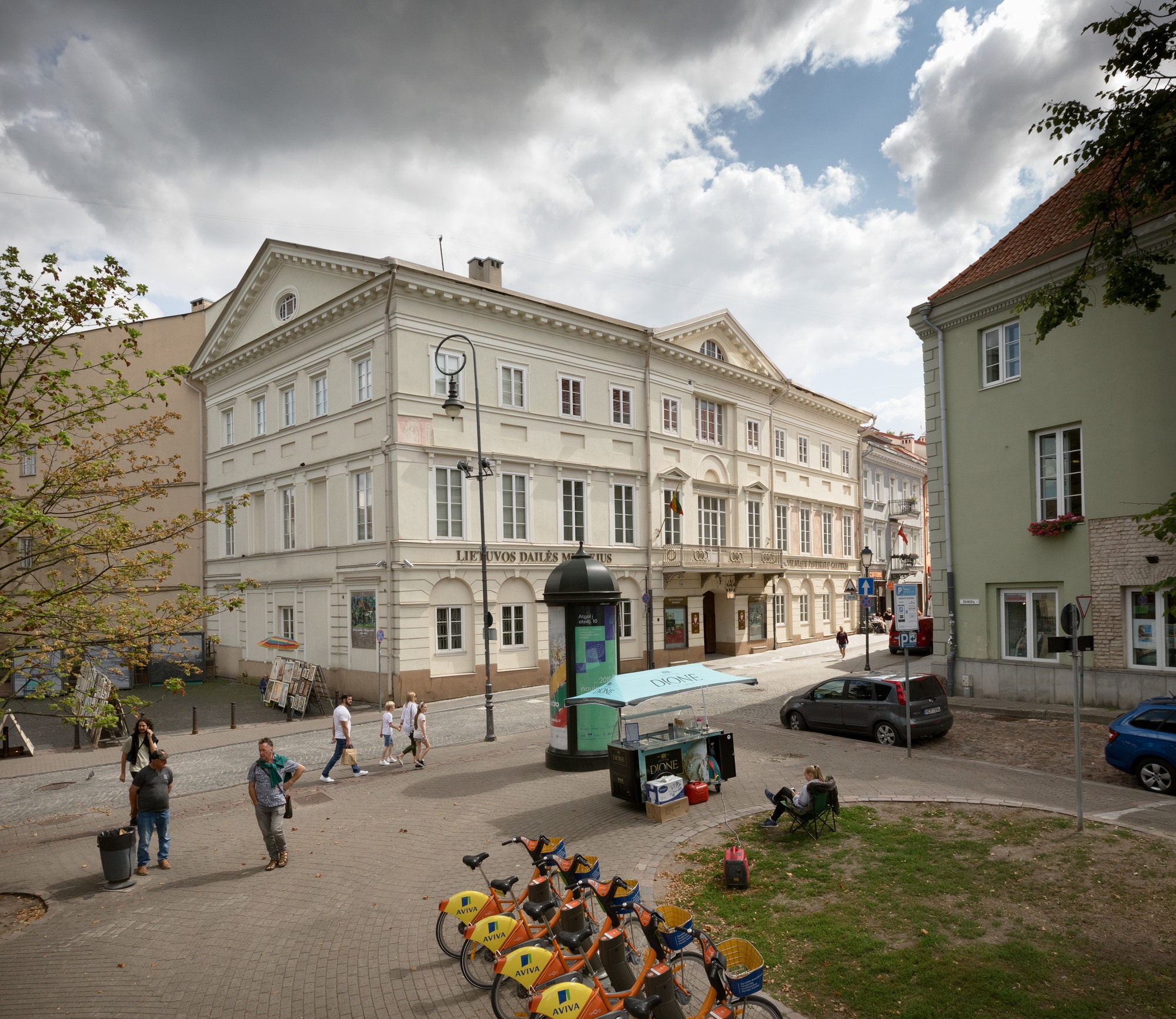
4 Didžioji Street. 2019
Photographer Tomas Kapočius
Lithuanian Art Museum
The Chodkiewicz family had owned houses on the site of the present-day palace as early as mid-1500’s. By the mid-1600’s, the noble family had expanded their property from Didžioji to Bokšto street by gradually adding the neighbouring plots and merged the existing buildings. At least eight generations of the Chodkiewicz family of the Supraśl branch are known to have lived in the palace. It is said that the Chodkiewiczes had an ongoing rivalry with Radziwiłłs, another noble family of the Grand Duchy of Lithuania. One of their clashes supposedly took place in this palace in 1600, when the Radziwiłłs, who competed with the Chodkiewiczes over the dowry of Princess of Slutsk Sophia Olelkovich, arrived at the palace with cannons and two thousand soldiers. The Chodkiewicz family sold the palace in the early 19th century. In 1812, it became a refuge for the retreating Napoleon forces. The overrun buildings were renovated in 1825 (allegedly by Tomasz Tyszecki): a second storey added, southern and northern wings prolonged, a service wing erected, thus forming a representational inner courtyard. The palace acquired features common to the late Classical architecture, which it has kept to the present day. In 1834, the palace was given to the Medical and Surgical Academy and became a student dormitory. Later on, it was used by various authorities, whereas the spacious halls were partitioned into flats. In 1919, the palace was handed over to Stefan Batory University and served as housing for the university lecturers until the 1980’s. Among its inhabitants were economist Vladas Jurgutis, nicknamed the „father of the Lithuanian litas,“ philosopher Vosylius Sezemanas and others. The service wing was turned into a Clinic for the Higher Education. There was a shoe shop and a drugstore operating in the palace. In 1981, the palace underwent a major renovation, provisions were made for a luxurious restaurant, which never came to reality. After the restitution of independence, the Chodkiewicz palace was given to the Lithuanian Art Museum and became the Vilnius Picture Gallery as well as the headquarters of the Museum administration.
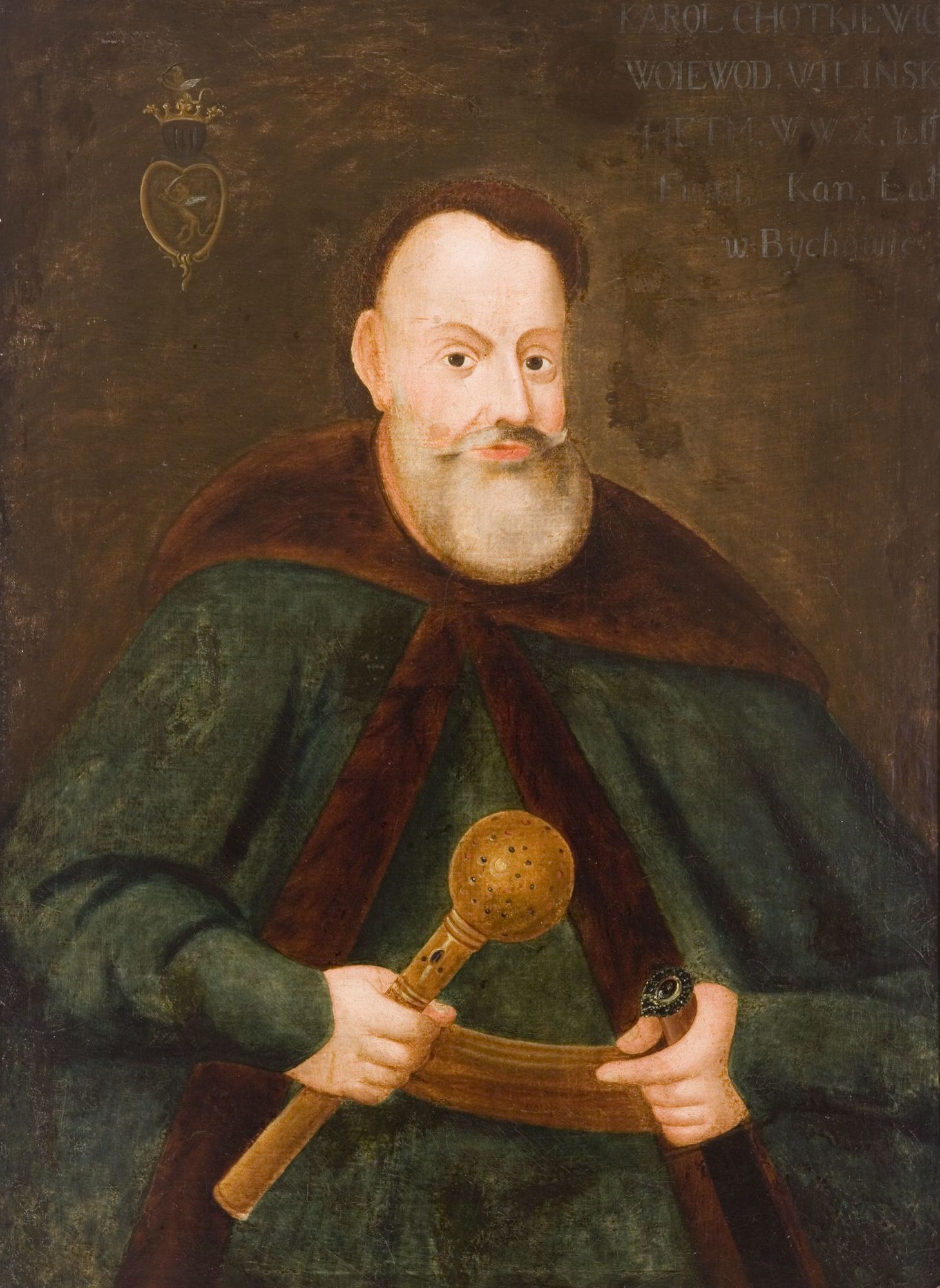
Unknown artist
Grand Hetman of Lithuania, Voivode of Vilnius Jan Karol Chodkiewicz. 17th century
Oil on canvas
Lithuanian Art Museum
JAN KAROL CHODKIEWICZ (1561–1621)
State and cultural figure of the Grand Duchy of Lithuania, one of the renowned military commanders of early–17th century Europe. Owned a palace on Didžioji street (currently 4 Didžioji st.) Studied at Vilnius, Ingolstadt and Padua universities. Visited Venice, Italy, the Netherlands, France and Spain. Field Hetman of Lithuania from 1600. Commanded Lithuanian troops in the war against Swedish invasion in Livonia in 1602–1611. His greatest victory was in the 1605 Battle of Kircholm (modern Salaspils), where he defeated the King Of Sweden Charles IX’s army several times the size of his force. Soon after was named the Great Hetman of Lithuania. Led the Polish–Lithuanian Commonwealth army during the advance on Moscow in 1611–1612 and during the war on Russia in 1617–1618. Named Voivode of Vilnius in 1616. Commanded the Polish–Lithuanian Commonwealth army in the war with Turkey in 1620–1621. Took part in the 1621 Battle of Khotyn, which, according to historians, determined the fate of the Central Europe, and successfully withstood a siege of a much larger Ottoman army. Died the same year, following an illness.