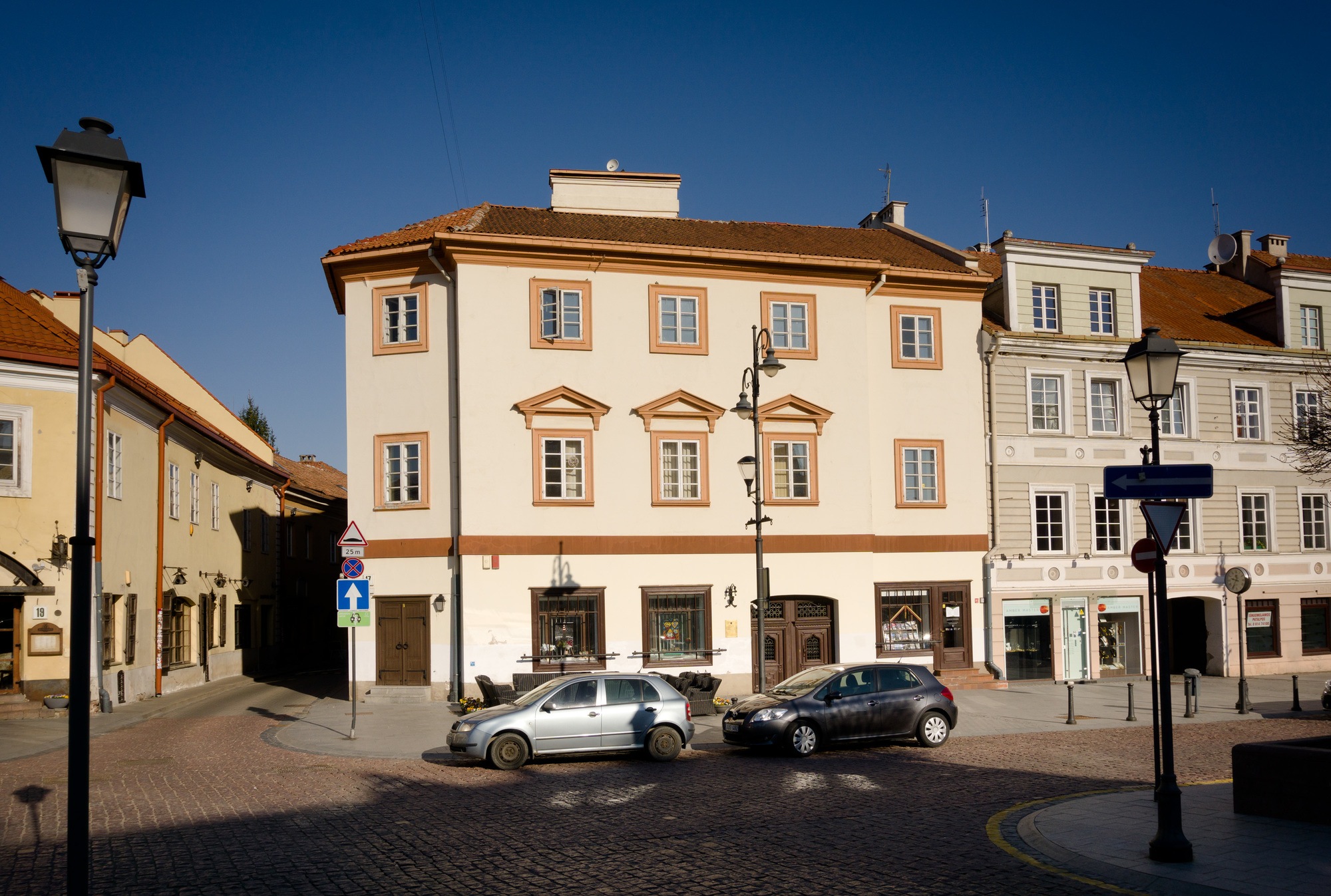
17 Didžioji Street. 2019
Photographer Tomas Kapočius
Lithuanian Art Museum
The house was erected on the foundation of a previous Orthodox church, which had been built in the 16th century in the shape of an irregular rectangle and had an apse looking out on Didžioji street. Like most of Vilnius Orthodox churches, it was given to the Uniates in 1609. The church suffered from several fires in the 17th and 18th centuries. In 1799, the remnants of its walls were used in the construction of a three-storey residential building. In the 19th century, the house had shops on the ground floor and flats on the upper floors. Standing on a juncture of Didžioji and Stiklių street, this building was on the border of the Vilna Small Ghetto, established in 1941. In the Soviet era, a tailor shop operated on its ground floor. After the reconstruction in the 1980-1990’s, the previous wooden galleries with stairs spanning around the tight inner yard were recreated. Currently it is occupied by the Genocide and Resistance Research Centre of Lithuania.